The short answer
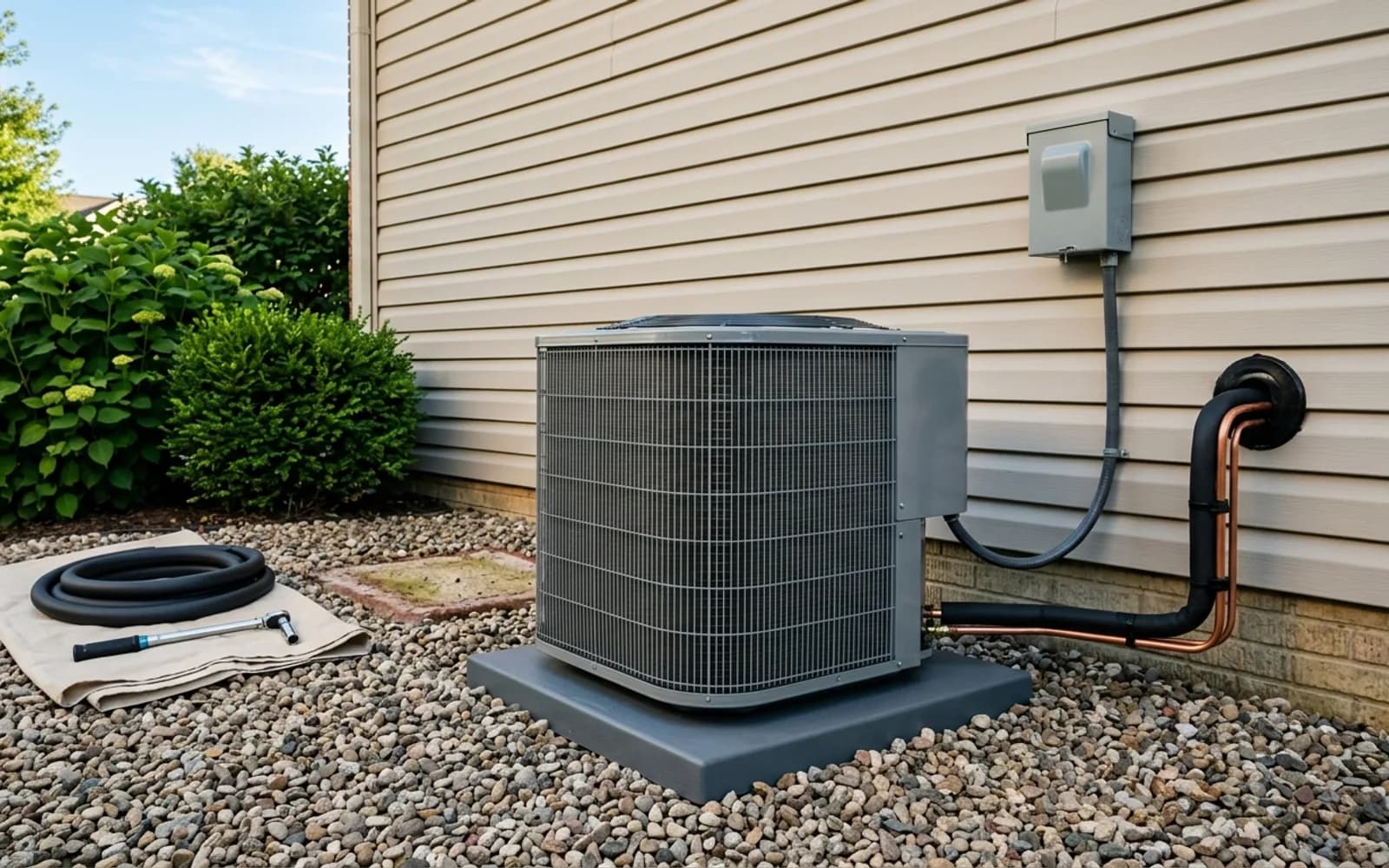
For a standard-tier 3-ton system on a clean straight swap, our published planning band is $6,000 to $9,800 installed, reviewed August 16, 2026. Better-tier equipment moves the band to $7,200 to $12,800 and premium variable-capacity equipment to $9,500 to $16,800, all before duct, electrical, line-set, access, control or permit work is added. Those add-ons, not the brand, are why two 3-ton quotes can differ by $6,000.
A 3-ton central air conditioner is a nominal 36,000 Btu/h system, and it is the most common residential replacement size in the US. That is why it is the size buyers most often try to price, and the size that most often produces two quotes thousands of dollars apart for the same house.
This page publishes the bands we use, the priced scope lines that move them, and three worked totals. The numbers below come from our own cost model, data version 2026-07-10, reviewed August 16, 2026. They are dated editorial planning bands, not verified market averages, and the method section says exactly how they were built and what they are not.
What 3 tons means on the quote
Nominal capacity is a label, not a measurement. A 3-ton outdoor unit is nominally 36,000 Btu/h, but the sensible and latent capacity it actually delivers depends on the indoor match, airflow, and outdoor conditions. The rating that belongs to your system is the certified rating of the outdoor and indoor combination, not the outdoor cabinet alone.
Two things need to be true before a 3-ton price is even the right question:
- A room-by-room Manual J load calculation supports 3 tons. Copying the old nameplate is not a load calculation.
- The quote names both model numbers and an AHRI reference for the pair. Without it you are pricing a cabinet, not a system.
If the capacity is still unconfirmed, start at what size air conditioner you need instead of at price.
3-ton installed price bands by equipment tier
These bands cover a base-scope replacement: outdoor equipment, a matched indoor coil, removal and disposal of the old unit, ordinary labor, and commissioning. They assume usable ducts, a usable existing circuit, a documented line-set reuse, ground-level access, the existing thermostat, and a permit already priced into the quote. Every scope line beyond that is added separately in the next table.
| Equipment tier for 3 tons | Installed planning band | What the tier buys | Typical compressor |
|---|---|---|---|
| Standard | $6,000 to $9,800 | Meets the regional minimum efficiency, simplest controls, fewest service dependencies | Single-stage |
| Better | $7,200 to $12,800 | Higher SEER2, better part-load humidity control, often a variable-speed indoor blower | Two-stage or high-efficiency single-stage |
| Premium | $9,500 to $16,800 | Variable capacity, lowest sound, finest humidity control, communicating controls | Inverter-driven variable capacity |
The floor under the standard tier is regulatory, not editorial. DOE's regional guidance names 14.3 SEER2 as the minimum for split-system air conditioners installed in the Southeast and Southwest regions on or after January 1, 2023, and treats a 13.4 SEER2 coil-only combination as installable only outside those regions. A quote that is cheap because it uses equipment your region does not allow is not a bargain.
The scope add-ons that move a 3-ton quote
This is the table the first quote usually leaves out. Each add is a planning range for a 3-ton job in USD, taken line for line from the same cost model, reviewed August 16, 2026.
| Scope line | Planning add (USD) | Why it goes missing from the first quote | How to force it into writing |
|---|---|---|---|
| Matched indoor coil | $0, included in the band | Nothing to hide, but the model number often is | Require the indoor model number and the AHRI reference |
| Old equipment removal and disposal | $0, included in the band | Occasionally rebilled later as a separate disposal fee | Ask whether removal, haul-away and disposal are inside the total |
| Condensate drain, trap, pump or overflow protection | Not published in our model | Treated as a detail until it floods a ceiling | Require the drain route, the trap, and whether a pump or float switch is included. See the condensate drain guide |
| Air handler instead of a coil | $1,500 to $3,500 | Quoted as "condenser replacement" when the indoor unit also has to go | Ask which indoor equipment is being reused and why it is compatible |
| Furnace and coil together | $3,000 to $7,000 | Bundled projects get one lump total with no split | Ask for the AC-only price and the furnace price separately |
| Duct repair, sealing, one or two returns | $800 to $2,500 | No one measured airflow, so no one priced it | Ask for static pressure and CFM readings before and after |
| Major duct rework | $2,500 to $7,000 | Diagnosed after demolition, priced as a change order | Require a written duct assessment before signing |
| Full duct replacement | $8,000 to $20,000 | Rarely proposed by the cheapest bidder | Get a second opinion before accepting this scope |
| Duct condition unknown | $0 to $3,000 allowance | The attic or crawlspace was never entered | Keep the allowance visible with a written cap |
| New or resized circuit and disconnect | $400 to $1,800 | Assumed the old circuit fits the new unit | Require the MCA and MOCP of the quoted model against the existing breaker. See the electrical scope guide |
| Panel work or service upgrade | $2,500 to $6,500 | Discovered on install day | Ask whether a licensed electrician has looked at the panel |
| Electrical condition unknown | $0 to $1,500 allowance | No one opened the panel | Keep the allowance visible with a written cap |
| Line-set replacement | $800 to $2,500 | Reuse assumed, never documented | Ask for the reuse procedure or the replacement price |
| Line-set reuse not documented | $0 to $1,500 allowance | Line size and cleanliness were not checked | Require the size check and flush or evacuation plan in writing. See the line-set reuse test |
| Difficult access, attic, crawlspace, tight side yard | $800 to $3,000 | Labor hours estimated from the driveway | Have the installer walk the actual equipment path |
| Roof set or crane | $1,500 to $6,000 | Subcontracted and quoted later | Ask who lifts the equipment and whether it is in the total |
| New thermostat or communicating controls | $500 to $2,000 | Premium equipment needs a control the quote omits | Ask which control the quoted model requires, and its replacement cost |
| New zoning system | $3,000 to $9,000 | Sold as comfort, priced as an afterthought | Require a duct design that supports the zoning |
| Permit not confirmed | $200 to $1,200 allowance | The quote does not say who pulls it | Ask for the permit line, the fee, and who schedules inspection |
Our older installed cost overview explains what each part of the project is. This table prices it.
Three 3-ton quotes, priced line by line
Same house size, same tonnage, three different scopes. The arithmetic is shown so you can rebuild it with your own lines.
Scenario A. Clean straight swap, standard tier. Accessible equipment, usable ducts, existing circuit fits, documented line-set reuse, permit included.
| Line | Low | High |
|---|---|---|
| Standard-tier 3-ton base | $6,000 | $9,800 |
| Matched coil | $0 | $0 |
| Ducts, electrical, line set, access, controls, permit | $0 | $0 |
| Total | $6,000 | $9,800 |
Scenario B. Swap with duct and electrical corrections, better tier. Two returns added, a new circuit, a replaced line set, permit included.
| Line | Low | High |
|---|---|---|
| Better-tier 3-ton base | $7,200 | $12,800 |
| Duct repair and returns | $800 | $2,500 |
| New circuit and disconnect | $400 | $1,800 |
| Line-set replacement | $800 | $2,500 |
| Total | $9,200 | $19,600 |
Scenario C. Premium variable-capacity with furnace and coil. Combined heating and cooling replacement, communicating control, minor duct work, permit included.
| Line | Low | High |
|---|---|---|
| Premium-tier 3-ton base | $9,500 | $16,800 |
| Furnace and coil | $3,000 | $7,000 |
| Communicating controls | $500 | $2,000 |
| Duct repair and returns | $800 | $2,500 |
| Total | $13,800 | $28,300 |
Scenario A and Scenario C are both honest 3-ton quotes. The gap between $6,000 and $28,300 is scope and tier, not sales trickery, which is why a tonnage-only price question cannot be answered with one number. Pin the tier and the scope lines and the band narrows to something you can actually negotiate against.
Is your 3-ton quote fair, negotiable, or a walk away
Build your own scope-adjusted band from the two tables above, then place the quoted total against it. The thresholds below are the ones our cost model publishes, not a market survey.
| Where the total lands | What our model calls it | What to do |
|---|---|---|
| Below 95 percent of your band's low end | Below range | Do not celebrate yet. Find which equipment, labor, permit, duct, electrical or startup line was left out |
| Between 95 and 105 percent of the band | Within range | Fair on price. Now compare exact models, written scope, commissioning readings and labor coverage |
| Above 105 percent of your band's high end | Above range | Negotiate. Ask which access, duct, electrical, indoor-equipment, warranty or premium-control work explains the difference |
Four conditions make it a walk away regardless of price: no indoor model number, no load calculation or defensible written sizing basis, a permit described as optional, and a refusal to put duct, line-set and electrical scope in writing with a capped allowance. Our quote comparison worksheet covers the full 16-line check, and you can send the proposal for an independent read.
Reading 3 tons off the model number
Manufacturers encode nominal capacity in the outdoor model number, usually as thousands of Btu/h. That gives you a 10-second check that the quote is actually for the tonnage it claims. Here is what three manufacturers published as of August 16, 2026.
| Manufacturer and current family | 3-ton outdoor model as published | Nominal cooling | Refrigerant | Sound | Certified SEER2 for the pairing |
|---|---|---|---|---|---|
| Goodman GLXS4B | GLXS4BA3610A | 36,000 Btu/h | R-32 | 67.0 dBA | Not published in the spec sheet. Goodman directs to AHRI system ratings in its System Configurator |
| Trane 14 single-stage, 5TTR4 | 5TTR4036A1000A | 3 nominal tons | R-454B | Not published on the product page | Not published on the product page |
| Carrier Comfort 16, 26SCA5 | Not published on the consumer product page | Not published | Not published | Not published | Not published |
Goodman's own nomenclature table maps digits 8 and 9 of the model number directly: 36 means 3 tons. Trane's model 5TTR4036A1000A carries the same 036. So the check is simple. If the outdoor model number on your quote does not contain 36 or 036, it is not a 3-ton unit, whatever the proposal says in words.
Note what the last column shows. None of the three publishes a certified SEER2 for a specific 3-ton indoor and outdoor pairing on the pages a homeowner can reach. That rating exists only in the AHRI Directory, which is exactly why the AHRI reference number belongs on your quote. Two current systems in this table also run different refrigerants, R-32 and R-454B, which our R-454B and R-410A comparison covers in detail.
Permits are a local fee, not a national average
Permit cost is set by your jurisdiction and published by it. Two examples we checked on August 16, 2026:
| Jurisdiction | Published fee for the AC permit | Effective |
|---|---|---|
| San Diego, CA | $131.52 per condensing unit for HVAC on single-family, duplex and townhouse property, plus a $12.16 mapping fee when plans are used | May 2026 |
| Duluth, MN | $101.00 flat Level 1 permit covering air conditioner install and miscellaneous work, up from $71.12 in 2025 | 2026 |
Both are well under the top of our $200 to $1,200 permit line. That line is not a fee estimate. It is the exposure our model keeps visible when the quote does not confirm who pulls the permit, and it covers fee plus the contractor's handling and inspection time. Once the quote names the permit and the fee, that allowance goes to zero.
What changed in 2026 that moves the number
- The federal 25C credit is gone for a 2026 install. The IRS states the credit is allowed for qualifying property placed in service on or after January 1, 2023, and before December 31, 2025, and ENERGY STAR states the credits are available "Through December 31, 2025". A qualifying central AC previously earned up to $600 inside a $1,200 annual cap. For equipment placed in service in 2026 that line is $0. Check current status on our 2026 tax credit page before you assume a rebate.
- New equipment ships on the new refrigerants. Of the two manufacturers that publish a 3-ton model number, Goodman's GLXS4B line is R-32 and Trane's 5TTR4 line is R-454B, both verified August 16, 2026. Neither is a reason to panic-buy, but the line-set and service implications belong in the quote.
- Electricity is the number to test savings claims against. The EIA's Electric Power Monthly, released July 23, 2026, puts the US average residential retail price at 18.44 cents per kWh for May 2026, up from 17.37 cents a year earlier. Use that rate, not a salesperson's assumption. As pure arithmetic, a $2,400 tier upgrade has to save about 13,000 kWh over its life to break even at 18.44 cents. Whether your house saves that depends on runtime, ducts, sizing and install quality, which is why we publish no payback promise. Our SEER2 guide explains what the rating does and does not predict.
How we built these numbers
- What they are. Dated editorial planning bands from the cost model that also drives our sizing and cost calculator, data version 2026-07-10, reviewed August 16, 2026. Every band in the tables above is published in that model, line by line, so the same inputs always produce the same range.
- How the base band is set. Nominal tonnage is rounded to the nearest half ton, then a tier add is applied, then each scope line adds its own range. Nothing is averaged from listing prices or scraped from contractor sites.
- Which criteria were weighed. Scope completeness first, then equipment tier, then site conditions. Brand is not an input to the band, because installer scope and site work move a 3-ton total further than the badge does.
- What we deliberately excluded. Regional labor multipliers, city-level price indexes, and any national installed-price average. No federal agency publishes installed residential AC prices, and we will not manufacture one.
- Primary sources behind the dated claims. DOE for the regional efficiency minimum, IRS and ENERGY STAR for the 25C status, EIA for the electricity rate, manufacturer spec sheets for the model-level rows, and the two cities' own published fee schedules for permit fees. All checked August 16, 2026, and listed in Sources.
What we could not verify
Stating this is part of the method, not an apology for it.
- No verified national installed price for a 3-ton system exists. Carrier publishes a range of $3,000 to $15,000 for a central air conditioner including installation, checked August 16, 2026, but that page states it excludes furnace, evaporator coil and ductwork modifications, and gives no method or sample size. We cite it as a manufacturer's published range, never as a market average.
- ENERGY STAR's certified central air conditioner dataset returned no rows. On August 16, 2026, the "ENERGY STAR Certified Central Air Conditioners" view (dataset id tyr2-hhgu) returned a row count of zero, and its parent dataset now publishes heat pumps only. We could not build a certified 3-ton model table from ENERGY STAR data and did not substitute retailer listings for it.
- Certified SEER2 per 3-ton pairing is not published by the manufacturers we checked. Goodman's spec sheet states its AHRI system ratings are accessible through its System Configurator, and neither Trane's nor Carrier's consumer pages publish a per-combination rating. Those cells say "not published" above because that is the honest answer.
- We publish no first-party 3-ton quote distribution. We have not collected enough reviewed 3-ton quotes to publish one. When we have, this page will carry the distribution and state how many quotes it came from. Until then, every number here is a planning band or a cited primary source, and none of it is presented as our own test data.
Frequently Asked Questions
Is $12,000 fair for a 3-ton AC?
It depends entirely on the tier and the scope, and both are knowable before you decide. For a standard-tier straight swap our band tops out at $9,800, so $12,000 sits above range and needs an explanation. For a better-tier system with duct corrections, a new circuit and a new line set, $12,000 lands inside a $9,200 to $19,600 band and is a reasonable number. Ask which of the two your quote actually is.
What does a 3-ton AC cost with new ductwork?
Add the duct line to the tier band. Repairs, sealing and one or two added returns add $800 to $2,500. Major rework adds $2,500 to $7,000. Full duct replacement adds $8,000 to $20,000, so a standard-tier 3-ton system with a full duct replacement plans at $14,000 to $29,800. Do not accept full duct replacement without a written duct assessment. Our duct replacement guide covers what that assessment should contain.
Why do two 3-ton quotes differ by $6,000?
Almost always because the tier or the scope differs, not because one contractor is greedy. A premium variable-capacity unit alone is $3,500 to $7,000 above a standard-tier one. A new circuit, a replaced line set and duct corrections add another $2,000 to $6,800. Put both quotes into the same scope table and the gap usually explains itself. If it does not, one quote is missing a line the other one priced.
How much should the 3-ton unit cost by itself?
That is the wrong unit of comparison, and it is the single most common way a cheap quote wins. The outdoor cabinet is one line in a project that also includes the indoor match, refrigerant work, electrical, drainage, permit and commissioning. Carrier's own price page puts central air conditioning at $3,000 to $15,000 including installation while explicitly excluding the coil, the furnace and duct changes, which is a good illustration of how much sits outside an equipment number.
Is a 3-ton AC big enough for a 1,800 square foot house?
There is no reliable square-foot answer, and a wrong one is expensive in both directions. A 3-ton system is nominally 36,000 Btu/h, but the design load depends on climate, windows, insulation, air leakage, orientation, occupants and duct condition. Oversizing causes short cycling and poor humidity removal. Require a room-by-room Manual J before accepting any tonnage.
Sources
- Goodman GLXS4B R-32 product specifications, SS-GLXS4B-R32
- Goodman GLXS4B air conditioner product page
- Trane 14 single-stage air conditioner, model list
- Carrier air conditioner lineup
- Carrier air conditioner prices, 2026
- DOE central air conditioner regional standards guidance
- IRS Energy Efficient Home Improvement Credit
- ENERGY STAR federal tax credits
- EIA Electric Power Monthly, Table 5.6.A average retail price of electricity
- City of San Diego Information Bulletin 103, mechanical permit fees
- City of Duluth permit fees
- ENERGY STAR Certified Central Air Conditioners dataset
- AHRI Directory of Certified Product Performance
- ACCA Manual J Residential Load Calculation
- ENERGY STAR quality HVAC installation
How this guide is checked
Written by Air Conditioner Guide Editorial Team. Editorial review by Air Conditioner Guide Editorial Team, last reviewed August 16, 2026. We check the sizing logic, quote-scope claims, and sources. No affiliate ranking bias.
Have a proposal?
Check the quote before you sign.
We'll look at the model match, capacity basis, install scope, warranty, and missing questions. Free, independent, no lead auction.
Check my quoteRelated guides

12 Air Conditioner Buying Mistakes to Avoid
Avoid the AC buying mistakes that create oversized equipment, missing scope, unverifiable efficiency, weak warranties, and expensive change orders.
Read the guide
Central Air Conditioner Cost: The Installed Price
A central AC replacement is more than the outdoor unit. Compare equipment, duct, electrical, permit, refrigerant, and labor costs line by line.
Read the guide
How to Compare AC Quotes Line by Line
Use this AC quote checklist to compare model numbers, capacity, SEER2, refrigerant, ducts, installation scope, warranty, and commissioning.
Read the guide