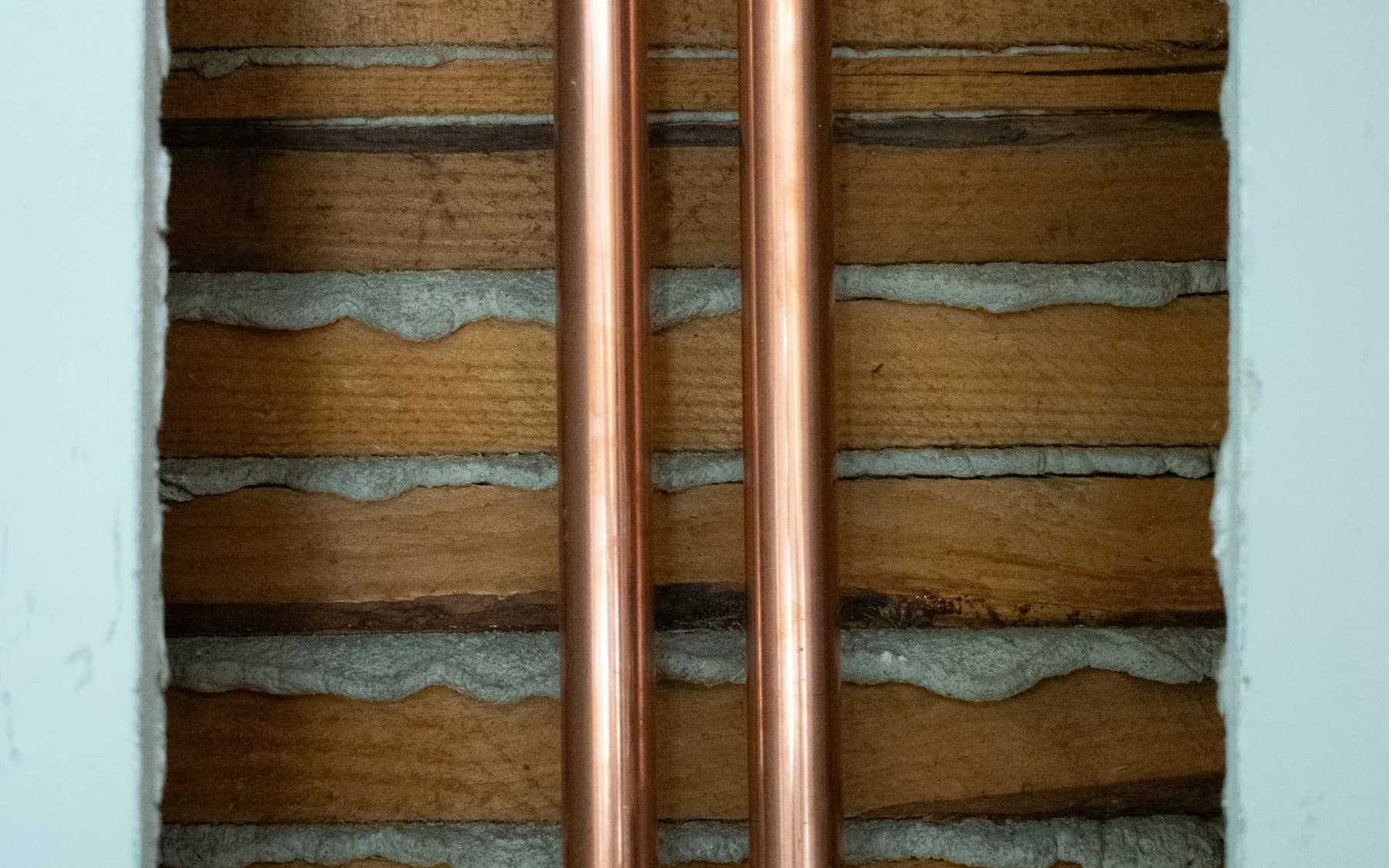
The short answer
Yes, an existing AC line set can sometimes be reused, including on some R-410A-to-R-454B replacements, but only when the exact new-equipment instructions allow it. Diameter, length, lift, condition, contamination history, joints, insulation and routing must pass inspection. The quote should name the manufacturer-approved preparation, nitrogen pressure test, leak check, evacuation and responsibility if the old tubing fails. Replace a damaged, contaminated, incorrectly sized or unapproved line set.
An existing AC line set does not need to be replaced simply because the outdoor unit is new. It also should not be reused simply because the copper is hidden in a wall.
The controlling answer is the installation manual for the exact new outdoor and indoor equipment, applied to the measured tubing and its history. A contractor preference or a general statement about refrigerants is not enough.
Quick decision table
| Existing condition | Better starting decision | Why |
|---|---|---|
| Correct diameter and length, accessible joints, clean history, manufacturer permits reuse | Reuse can be reasonable | Avoids unnecessary demolition while keeping a testable installation |
| Wrong diameter, excessive length or lift | Replace or redesign | The new system's piping limits control capacity, oil return and charge setup |
| Compressor burnout or known contamination | Replace | New equipment should not inherit a contaminated circuit |
| Kinks, corrosion, rub-through or repeated repairs | Replace | Pressure testing does not repair weak or damaged tubing |
| Long concealed run with no documented size or route | Investigate before pricing | The quote needs measurements and a failure contingency, not an assumption |
| R-410A line set with new R-454B equipment | Model-specific decision | Some manufacturers allow reuse under explicit sizing, cleaning and testing rules; others may not |
Can an R-410A line set be reused for R-454B?
Sometimes, yes. The refrigerant change alone does not automatically condemn the copper. The new R-454B system's manufacturer must permit the exact line size, length, preparation method and installation.
Two current manufacturer examples show why the answer must stay model-specific:
- Bosch says an existing R-410A line set may be reused for its applicable R-454B equipment when it is properly sized, flushed or purged with dry nitrogen, pressure-tested to Bosch requirements, leak-free and code-compliant.
- An Allied Air R-454B installation manual permits reuse of an existing line set when it is correctly sized and not contaminated, with the specified flushing procedure. It says not to reuse the line set after a compressor burnout.
Those are examples, not blanket permission for another brand or model. Put the exact installation-manual section in the job file.
R-410A and R-454B are not interchangeable refrigerants. R-454B is an A2L refrigerant, so the complete listed installation can include additional safety, charge, room-volume, detection or mitigation requirements. See the R-454B vs R-410A buyer guide for the wider equipment decision.
The eight-part reuse test
| Check | Evidence the quote should name | Replace or stop if |
|---|---|---|
| Diameter | Measured liquid and suction sizes compared with the exact manual | Either size is outside the approved table |
| Length and rise | Total equivalent length and vertical lift | Route is unknown or beyond the model limit |
| Condition | Inspection of exposed tubing, joints, supports and bends | Kinks, corrosion, rub-through or poor repairs are present |
| Contamination history | Old compressor failure mode and oil/circuit condition | Burnout, acid or debris risk cannot be cleared under the manual |
| Routing | Concealed and exposed path, service access and protection | The route is unprotected or cannot meet current instructions |
| Insulation | Condition and thickness of suction-line insulation | Insulation is wet, damaged, inaccessible or insufficient |
| Manufacturer approval | Exact model manual and reuse procedure | Approval is missing, generic or for a different equipment family |
| Test and commissioning | Required pressure, hold method, leak check, evacuation and charge method | The contractor will not document the completed test |
One failed check can change the answer. A successful visual inspection does not replace pressure testing, and a pressure test does not prove correct diameter or cleanliness.
What "flush and reuse" must mean in the quote
The phrase alone is incomplete. The written scope should identify:
- Existing liquid and suction diameters, approximate length and vertical rise.
- The exact outdoor and indoor model numbers.
- The installation-manual section that permits reuse.
- The manufacturer-approved cleaning, flushing or dry-nitrogen procedure.
- Which old components, filter-driers, fittings and accessible damaged insulation will be replaced.
- The required nitrogen pressure-test value, hold method and leak-verification step.
- The evacuation and final charge procedure for the new equipment and actual line length.
- What happens, and who pays, if the concealed line fails before startup.
Do not turn the page into a DIY procedure. EPA requires Section 608 certification for technicians who maintain, service, repair or dispose of equipment in a way that could release regulated refrigerants.
Hidden line set: price both outcomes
The strongest reuse case is often a sound line set hidden behind finished walls, ceilings or a slab chase. The cost and damage of replacement are real. That makes documentation more important, not less.
Ask for two scopes when the condition is uncertain:
| Scope | Must include |
|---|---|
| Reuse | Inspection, manufacturer approval, preparation, pressure test, evacuation, insulation work and a written failure contingency |
| Replace | New routing, wall or ceiling access, firestopping, exterior protection, finish repair, disposal and commissioning |
If a reused concealed line fails its pre-start test, the contract should already say whether the replacement becomes a fixed add-on, an allowance or a new change order.
Quote-ready language
Use this as a comparison prompt, then let the licensed contractor adapt it to the exact equipment:
Identify the existing liquid and suction line sizes, approximate length and vertical rise. Cite the new equipment manufacturer's section permitting reuse. Include the approved preparation method, nitrogen pressure test, leak verification, evacuation, insulation repair and final charge setup. State the added price and responsibility if the existing line fails testing or does not meet the new model's requirements.
Put the result beside every other scope line in the AC quote comparison guide. Check the completed work against the AC installation checklist, or use the independent quote review when proposals disagree.
Buyer verdict
Reuse is acceptable when it is a documented manufacturer-approved decision. Replacement is stronger when it removes a real sizing, contamination, condition or access risk.
Do not pay for automatic replacement without a reason. Do not accept automatic reuse without measurements, approval and tests. The best quote makes the reason, procedure and failure responsibility visible before work starts.
Frequently Asked Questions
Can you reuse an old line set with a new AC unit?
Yes, if the exact new system permits the existing diameter, length and route, the tubing is sound and clean, and the contractor follows the required preparation, testing and commissioning steps. Otherwise replace or redesign it.
Can R-410A copper lines be used with R-454B?
Sometimes. Bosch and Allied Air currently publish conditional reuse paths for applicable R-454B systems, but their instructions do not authorize reuse for every brand. The exact new-equipment manual controls.
Can an R-22 line set be reused?
Possibly, but the age of the installation, mineral-oil history, dimensions and contamination risk make the evidence burden higher. The new manufacturer must explicitly permit the proposed preparation and sizes. The old refrigerant is never reused in the new system.
Does a pressure test prove the line set is reusable?
No. It addresses leak integrity at the test conditions. It does not prove correct diameter, acceptable length, clean history, good insulation or manufacturer approval.
How long does an AC copper line set last?
There is no universal replacement age. Environment, corrosion, vibration, joint quality, contamination, insulation, routing and physical damage matter more than the calendar alone.
Who decides whether the line set can be reused?
The licensed installing contractor should apply the exact manufacturer instructions, inspect and test the tubing, document the result and accept responsibility for the written scope.
Method and sources
Technical claims were checked against current manufacturer and government sources on August 13, 2026. Manufacturer reuse rules are reported as model-family examples, not generalized across the market.
How this guide is checked
Written by Air Conditioner Guide Editorial Team. Editorial review by Air Conditioner Guide Editorial Team, last reviewed August 13, 2026. We check the sizing logic, quote-scope claims, and sources. No affiliate ranking bias.
Have a proposal?
Check the quote before you sign.
We'll look at the model match, capacity basis, install scope, warranty, and missing questions. Free, independent, no lead auction.
Check my quoteRelated guides
12 Air Conditioner Buying Mistakes to Avoid
Avoid the AC buying mistakes that create oversized equipment, missing scope, unverifiable efficiency, weak warranties, and expensive change orders.
Read the guide
AC Condensate Drain: Clogs, Traps, and Water Damage
Understand central AC condensate drains, pans, traps, pumps, overflow switches, clog symptoms, safe homeowner checks, and replacement-quote scope.
Read the guide
AC Electrical Safety: What Your Quote Should Cover
Understand the disconnect, breaker, and GFCI requirements a central AC replacement quote should include, and why the 2026 code deadline matters now.
Read the guide