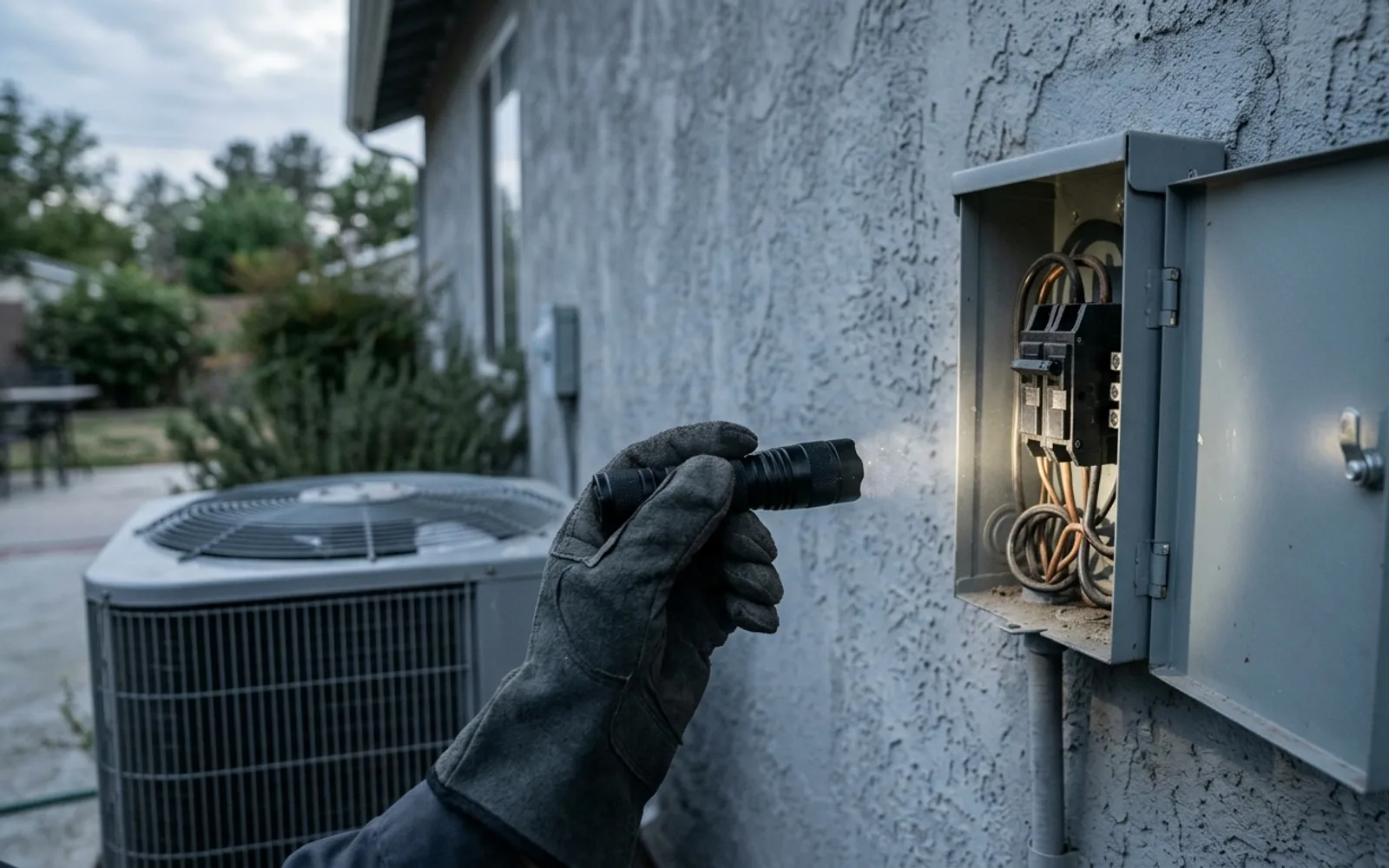
The short answer
A compliant central AC quote lists a dedicated disconnect within sight of the outdoor unit, a breaker sized to the equipment ampacity rating, and, on new work, GFCI protection at the disconnect or panel. A temporary National Electrical Code exception lets listed HVAC equipment skip GFCI protection, but that exception expires September 1, 2026. High-voltage electrical work belongs to a licensed electrician, not the HVAC installer alone.
A central AC replacement is not only a refrigerant and duct job. It also touches a dedicated electrical circuit, a disconnect switch, and, on new work, GFCI protection. A quote that skips the electrical line item is not a complete quote. The outdoor condenser needs its own breaker sized to the equipment's rated ampacity, a disconnect within sight of the unit, and, if it is new work, code-compliant ground-fault protection.
One near-term fact matters right now. The National Electrical Code's temporary exception that lets listed outdoor HVAC equipment skip GFCI protection expires September 1, 2026. If your quote or a builder's electrical panel still assumes the exemption applies, verify that before you sign.
What a compliant electrical scope looks like
| Item | What it means | What to verify in writing |
|---|---|---|
| Dedicated circuit and breaker | The outdoor unit gets its own circuit, sized to the equipment's specified minimum circuit ampacity and maximum overcurrent protection | The breaker size matches the nameplate or installation manual, not a generic "240V" line item |
| Disconnect switch | A disconnecting means located within sight (not more than 50 feet, with a direct line of view) and readily accessible from the outdoor unit, per NEC 440.14 | The disconnect is not hidden behind a fence, buried by landscaping, or mounted where it blocks the equipment nameplate |
| GFCI protection | Ground-fault circuit interrupter protection at the disconnect or panel, required for most outdoor dwelling outlets under NEC 210.8(F) | Whether your jurisdiction still allows the listed-HVAC-equipment exception, and whether that changes before September 1, 2026 |
| Permit and inspection | Most jurisdictions require an electrical permit for new or replaced circuits, pulled by whoever performs the work | Who is pulling the permit, and whether a licensed electrician, not just the HVAC installer, is doing the electrical connection |
| Working clearance | Clear space in front of the disconnect and panel so a technician can service the equipment safely | The installer has not shrunk clearance to fit the unit into a tight side yard |
The 2026 GFCI deadline, explained calmly
The 2020 NEC expanded GFCI protection to most outdoor dwelling outlets, and outdoor AC and heat pump disconnects were swept into that definition. HVAC manufacturers reported that some variable-speed compressors and ECM fan motors nuisance-tripped GFCI protection, so the code added a temporary exception: GFCI protection is not required for listed HVAC equipment, and that exception expires September 1, 2026.
This is not a reason to panic-replace a working disconnect today. It is a reason to ask two questions before you sign a new quote or accept a proposal that assumes the older rule:
- Does the local jurisdiction's currently adopted NEC edition still include the HVAC exception, or has the exception already expired there?
- If new equipment is installed after the exception lapses, does the quote's electrical scope include GFCI protection at the disconnect or panel, and who is responsible for that cost?
Code adoption timing varies by state and local authority having jurisdiction (AHJ). Ask your electrician or the local building department which NEC edition currently governs your permit, rather than assuming a single national deadline applies everywhere at once.
Who does the electrical work: the HVAC installer or an electrician?
Many HVAC contractors are licensed to make the final connection to an existing dedicated circuit. A new circuit, a panel upgrade, or a disconnect relocation is different work, and many jurisdictions require it to be performed or supervised by a licensed electrician and pulled under an electrical permit. Washington state's Department of Labor and Industries, for example, states that an electrical permit is required for most new, repaired, or replaced electrical work, and that whoever performs the work is responsible for obtaining it. Requirements and licensing exemptions vary by state, so confirm the rule with your local AHJ rather than assuming your HVAC contractor's license covers electrical work by default.
Ask your contractor directly:
- Is the electrical connection being made to an existing dedicated circuit, or is new wiring, a new breaker, or a panel change involved?
- If new wiring or a panel change is needed, who is licensed to do that work, and is it itemized separately in the quote?
- Is an electrical permit being pulled, and by whom?
Signs your existing disconnect needs professional attention
- The disconnect is rusted, cracked, or has a visibly melted or discolored faceplate.
- The disconnect is buried behind landscaping, fencing, or storage and is no longer within sight and readily accessible.
- The breaker trips repeatedly, which can indicate an undersized circuit, a failing component, or a wiring problem rather than a GFCI nuisance trip.
- There is no visible disconnect near the outdoor unit at all, which is common on older installations that predate current disconnect requirements.
None of these are DIY diagnoses. High-voltage electrical work is licensed-professional territory. If you see any of these signs, ask a licensed electrician to inspect the disconnect and circuit before your next AC service or replacement.
How this fits the rest of your quote
Electrical scope is one line item among several that separate a complete replacement proposal from an equipment-only price. Read how to compare AC quotes for the full line-by-line worksheet, and use the installation checklist to confirm electrical, permit, and commissioning items are documented at handoff. Our buying-mistakes guide covers the same "leaving electrical scope vague" mistake from the negotiating side.
If a written proposal is already in hand and the electrical line item still looks vague, an independent quote review can flag what is missing before you sign.
Buyer verdict
Do not accept "electrical included" as a line item. Ask for the circuit size, the disconnect location and type, whether GFCI protection is part of the scope, who is licensed to do the work, and whether a permit is being pulled. None of that adds meaningful cost to a proposal that was already going to do it correctly. It only becomes expensive when it is discovered after the outdoor unit is already set.
Frequently Asked Questions
Does a new central AC need a permit?
Most jurisdictions require a permit for new or replaced electrical circuits and equipment connections, and whoever performs the work is typically responsible for pulling it. Requirements vary by state and local authority, so confirm with your building department rather than assuming your contractor has automatically handled it.
Do I need a GFCI outlet for my outdoor AC unit?
It depends on your jurisdiction's currently adopted electrical code edition. A temporary exception lets listed outdoor HVAC equipment skip GFCI protection, but that exception expires September 1, 2026. Ask your contractor or local building department whether the exception still applies where you live.
Can my HVAC installer do all the electrical work?
Many HVAC contractors can connect equipment to an existing dedicated circuit. New wiring, a new breaker, or a panel change often requires a licensed electrician and a separate electrical permit. Confirm who is licensed to perform each part of the job before you sign.
Where does my AC disconnect need to be located?
The disconnect must be within sight of the outdoor unit, generally understood as no more than 50 feet with a direct line of view, and readily accessible without tools, ladders, or obstacles. It cannot be mounted where it blocks the equipment's nameplate.
Sources
How this guide is checked
Written by Air Conditioner Guide Editorial Team. Editorial review by Air Conditioner Guide Editorial Team, last reviewed July 19, 2026. We check the sizing logic, quote-scope claims, and sources. No affiliate ranking bias.
Have a proposal?
Check the quote before you sign.
We'll look at the model match, capacity basis, install scope, warranty, and missing questions. Free, independent, no lead auction.
Check my quoteRelated guides

12 Air Conditioner Buying Mistakes to Avoid
Avoid the AC buying mistakes that create oversized equipment, missing scope, unverifiable efficiency, weak warranties, and expensive change orders.
Read the guide
AC Condensate Drain: Clogs, Traps, and Water Damage
Understand central AC condensate drains, pans, traps, pumps, overflow switches, clog symptoms, safe homeowner checks, and replacement-quote scope.
Read the guide
Air Conditioner Maintenance Checklist
A central AC maintenance checklist separating safe homeowner work from technician checks for airflow, electrical, refrigerant, drains, and controls.
Read the guide