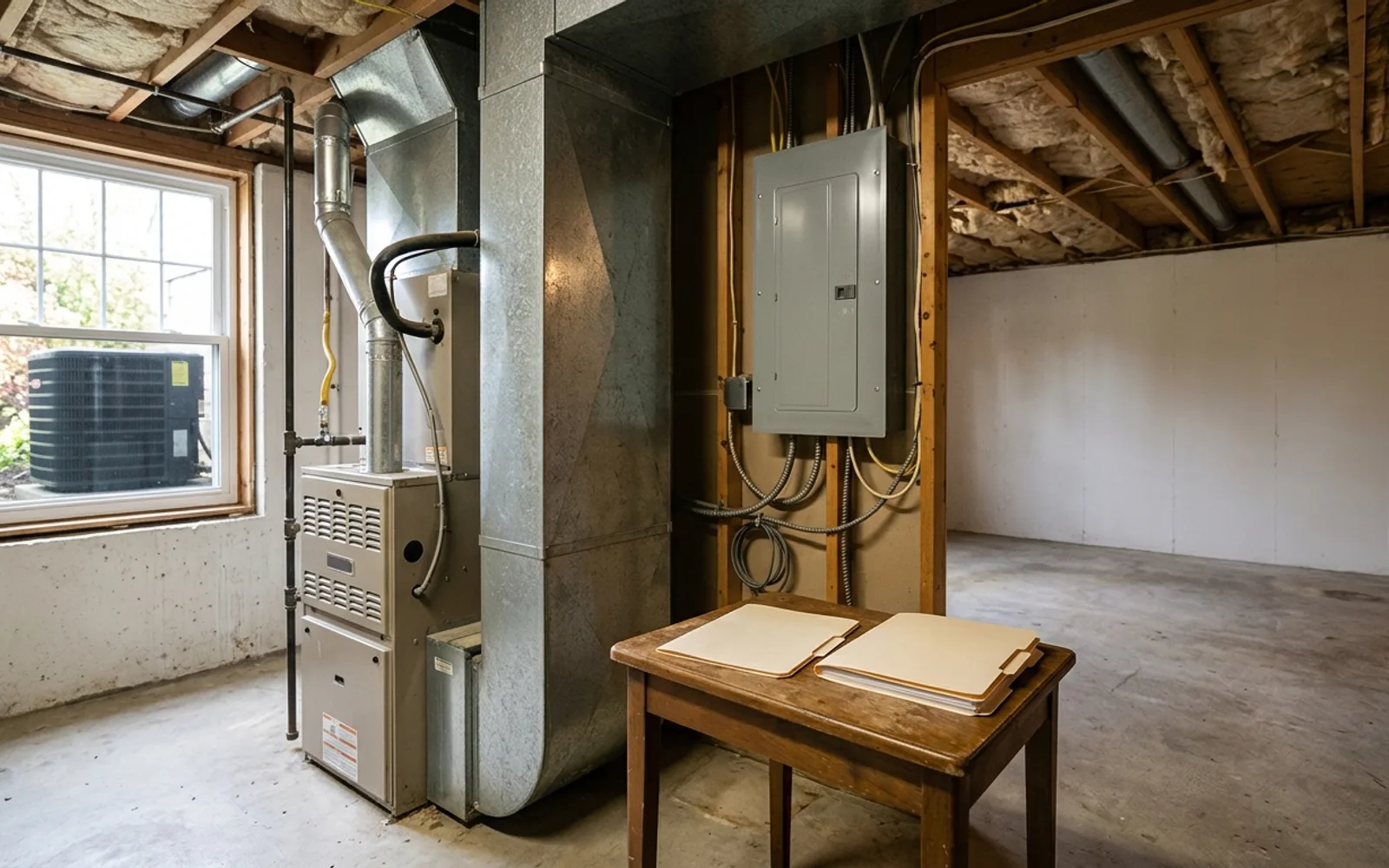
The short answer
If your home already has gas service and usable ducts, a like-for-like AC-plus-furnace replacement is often the cheaper install, and a heat pump has to clear a break-even electricity-to-gas price ratio to win on operating cost. Our arithmetic, at the June 2026 EIA electricity rate and the May 2026 EIA gas rate, puts that break-even around a 2.25 to 2.7 coefficient of performance, which most heat pumps clear in mild-to-cold weather and cold-climate models clear even in severe cold. If your home has no gas line, the comparison changes: the AC-plus-furnace path has to add a new fuel source from scratch, which a heat pump does not.
If gas is already piped to the house and the ducts are usable, a straight AC-plus-furnace swap is usually the cheaper install, and a heat pump has to beat a break-even efficiency ratio to win on the utility bill. At the EIA rates checked for this page, June 2026 electricity and May 2026 natural gas, that break-even lands around a 2.25 to 2.7 coefficient of performance (COP) depending on the furnace's efficiency, a bar most heat pumps clear except in the coldest weather. The comparison flips when there is no gas line: the AC-plus-furnace path then has to price a new fuel source from scratch, a cost most buyer guides skip entirely.
This page stays on the cooling-replacement decision, which is what aircondition.guide covers. For heating-first heat pump sizing, cold-climate model selection, and dual-fuel controls, the handoffs below go to the network's heat pump site.
The decision in one table
| Factor | AC plus furnace | Heat pump |
|---|---|---|
| Systems replaced | Two: outdoor condenser and coil, plus a separate furnace | One: outdoor unit and indoor coil or air handler do both jobs |
| Fuel needed | Gas, propane, or oil for heat; electricity for cooling | Electricity only, unless paired with a furnace for dual fuel |
| Ductwork | Reuses AC-era airflow assumptions | Often needs more heating-mode airflow; existing ducts may need a recheck |
| Electrical panel | Rarely a factor for AC alone | Backup electric heat can require a panel or circuit review |
| Federal incentive in 2026 | None; Section 25C ended for property placed in service after Dec 31, 2025 | None; the heat pump's larger former Section 25C cap also ended on the same date |
| Best fit | Homes with gas already installed, usable ducts, and a working furnace not worth replacing yet | Homes replacing both systems anyway, all-electric homes, or homes prioritizing one system over two |
Installed cost by case, not by a single number
A heat pump replacing a working furnace and a dying AC is not the same purchase as a heat pump replacing nothing but a dying AC in a house with a healthy furnace. Four cases, split by fuel availability and duct condition, price differently.
| Case | AC plus furnace | Heat pump |
|---|---|---|
| Gas available, ducts usable | Our own 3-ton model: standard-tier AC $6,000 to $9,800, plus furnace-and-coil scope $3,000 to $7,000, totals $9,000 to $16,800 | Manufacturer-published range $6,000 to $25,000; a state ratepayer program's 2022 data point for a whole-home ducted system averaged $22,000 before rebate |
| Gas available, ducts need correction | Same base, plus this site's duct-repair add $800 to $2,500, or major duct rework $2,500 to $7,000 | Same duct add applies, but confirm the correction sizes for the heat pump's heating-mode airflow, not just the AC's cooling airflow, before assuming the AC-scoped fix is enough |
| No gas line, ducts usable | Not published here. The AC-plus-furnace path now has to add a propane tank and furnace, or an electric-resistance furnace, neither of which this site's cost model or a verified primary source prices. Get that number in writing before comparing anything else | Same manufacturer and state-program ranges above; no new fuel infrastructure required since the home is already electric |
| No gas line, ducts need correction | Same unpriced fuel-source addition, plus the duct correction cost above | Manufacturer and state-program ranges, plus the duct correction cost above |
Sources for this table: our own 3-ton installed cost model, reviewed August 16, 2026; Carrier's 2026 heat pump cost guidance; and Mass Save's 2022 program-average figure for Massachusetts, the only state-program cost figure verified for this page. Neither manufacturer nor state-program numbers are a national average, and neither this site nor any federal agency publishes one.
The arithmetic that decides the operating cost
Two national rates settle most of the "which is cheaper to run" question, and the math is simple enough to redo with your own utility bill.
- US average residential electricity: 18.34 cents per kWh, June 2026, EIA Electric Power Monthly, released August 26, 2026.
- US average residential natural gas: $19.83 per thousand cubic feet (Mcf), May 2026, EIA, released July 31, 2026. Using EIA's published 2025 average heat content of 1,037 Btu per cubic foot, that is about $1.91 per therm.
A gas furnace at 80% AFUE, the current federal minimum, delivers 80,000 Btu of heat per therm burned, at a fuel cost of about $1.91 per 80,000 Btu, or $2.39 per 100,000 Btu delivered. A furnace at 95% AFUE, the high-efficiency condensing tier, delivers heat at about $2.01 per 100,000 Btu.
A heat pump's cost per 100,000 Btu delivered is (100,000 ÷ (COP × 3,412)) × $0.1834. Setting that equal to the furnace's cost per 100,000 Btu and solving for COP gives the break-even point:
- Against an 80% AFUE furnace: break-even COP is about 2.25.
- Against a 95% AFUE furnace: break-even COP is about 2.7.
A heat pump beats the furnace on operating cost whenever its real-world COP, at the outdoor temperature that matters, is above that number. Below it, the furnace is cheaper to run at these national rates. Your own numbers will differ: a higher local electricity price or a lower local gas price raises the break-even COP a heat pump must clear, and the reverse lowers it. Redo the math with your utility's actual per-kWh and per-therm or per-Mcf rates before deciding, since the national average can be well off your bill.
Where COP actually falls as it gets cold
DOE and AHRI rate heat pump heating performance at three standard outdoor test points: 47°F, 17°F, and 5°F. A heat pump's published COP is highest at 47°F and falls as the outdoor temperature drops, because the unit has to work harder to pull the same heat out of colder air. Two things follow:
- The manufacturer's headline efficiency number is a 47°F number. Ask for the capacity and COP at 17°F and 5°F for the exact model quoted, not just the top-line rating.
- Cold-climate models are built to hold COP and capacity better at low temperatures. DOE's Cold Climate Heat Pump Challenge field validation found that qualifying prototype units retained more than 70% of rated capacity and a COP between 2.0 and 3.5 at -15°F. The Northeast Energy Efficiency Partnerships' Cold Climate Air-Source Heat Pump specification is the industry list of models built to that standard, aimed at IECC climate zone 4 and colder.
Compare a specific quoted model's AHRI-certified capacity and efficiency at 47°F, 17°F, and 5°F against the break-even COP above, at your own utility rates, before accepting a contractor's blanket claim that a heat pump "will handle" your winter.
A climate decision table, not a single verdict
| Winter severity | What usually decides it | Typical call |
|---|---|---|
| Mild, rarely near freezing (design load stays well above the 47°F to 17°F test range) | Break-even COP is easy to clear almost all winter | A standard heat pump is usually the stronger buy on operating cost alone |
| Cold but not extreme (design load regularly runs into the 17°F to 5°F test range) | Capacity and COP both fall from the 47°F headline number; backup heat and duct airflow both need checking | A cold-climate (NEEP-listed) heat pump sized off its 5°F rating, not its 47°F rating |
| Severe cold (design load runs below 5°F, potentially near or below -15°F) | Even cold-climate units lean on backup heat more; DOE's Challenge data still shows meaningful capacity at -15°F, but the switchover economics matter more | Dual fuel (heat pump plus the existing furnace as backup) is common here, with the switchover set by the break-even math above, not a fixed date on the thermostat |
The network's cold-climate heat pump guide covers model selection for the second and third rows in more depth than this cooling-focused site does.
Ductwork: the airflow question most quotes skip
A gas furnace produces hot supply air, commonly well above what a heat pump's indoor coil produces in heating mode. To deliver the same amount of heat with cooler supply air, a heat pump generally needs to move more air, which asks more of the same ducts. Building-science engineer Allison Bailes at Energy Vanguard makes the point plainly: most furnaces are oversized well beyond the home's actual heating load, so the airflow the ducts already handle for an oversized furnace often has more slack than it looks like on paper. Neither fact is a guarantee for your house.
Before accepting a "your ducts are fine" claim for a heat pump replacement:
- Get a room-by-room Manual J load calculation so the heat pump is sized to the real load, not the old furnace's oversized nameplate.
- Ask for a measured static pressure and CFM reading on the existing duct system, the same request our duct replacement guide walks through for AC-only jobs.
- Ask the contractor to confirm the quoted heat pump's required heating-mode airflow against that measurement, not just the cooling-mode airflow an AC-only quote would check.
If the ducts were marked "usable" for an AC-only quote, get that confirmed again specifically for heat pump heating mode before assuming it still holds.
The panel and backup-heat question
A heat pump that includes electric-resistance backup heat can draw meaningfully more current than an AC-only replacement. New York's Clean Heat Connect program, an official state clean-heat initiative, gives contractors this rule of thumb for assessing existing electrical service:
| Existing main panel | Upgrade likelihood for a heat pump with backup heat |
|---|---|
| Under 100 amps, or panel installed before 1965 | Likely needs an upgrade |
| 100, 150, or 200 amps | Possibly needs an upgrade, depends on the load calculation |
| Over 200 amps | Unlikely to need an upgrade |
The same program notes that a heat pump can draw up to 60 amps during startup depending on size and style. Ask for a written electrical load calculation against your actual panel and circuit inventory, not a verbal assurance that "it'll be fine." Our electrical safety guide covers the disconnect and circuit basics that still apply on the cooling side of either replacement.
The network's backup heat sizing guide goes further into strip-heat staging once backup heat is part of the design.
2026 incentive status for both paths
Neither path carries a federal Section 25C credit for a system placed in service in 2026. Public Law 119-21 ended the credit for property placed in service after December 31, 2025. Before that date, the caps were meaningfully different: central air conditioners were capped at up to $600 per item, while heat pumps meeting the CEE's highest non-advanced efficiency tier were capped at up to $2,000 per year, a gap that mattered when the credit was live and one reason contractors still repeat a "$2,000 credit" line in 2026 sales conversations that no longer applies federally. Our 2026 AC tax credit page covers the AC side of that expiration in more detail; the same expiration date applies to the heat pump side of the same credit.
State, utility, and manufacturer rebates are separate programs that can still be active. Mass Save's 2026 heat pump rebate, for example, runs $2,650 per ton up to $8,500 standard, or up to $16,000 for income-qualified households, entirely apart from the expired federal credit. Check your own state energy office and utility before assuming either path gets a discount.
What we could not verify
- No single confirmed minimum HSPF2 figure for 2026 heat pumps. DOE's 2023 rule changed the test procedure used to rate heating efficiency (HSPF2) effective January 1, 2023, but a specific market-wide minimum number could not be confirmed against a primary federal source for this page. Check the AHRI-certified HSPF2 for the exact quoted indoor and outdoor combination rather than trusting a stated minimum.
- No sourced CFM-per-ton figure for heat pump heating mode versus furnace heating mode. The airflow difference described above is real and independently discussed by a credentialed building-science source, but no standards body publishes a single number that applies to every system. Get your own static-pressure and CFM measurement instead.
- No installed price for adding propane or electric-resistance heat to an all-electric home considering the AC-plus-furnace path. This is a real, often-skipped cost. Price it before comparing totals.
- No national average installed heat pump price. Carrier's manufacturer range and Mass Save's Massachusetts program average are cited exactly as that, a manufacturer figure and a single state's program data, never blended into a claimed national number.
Frequently Asked Questions
Is a heat pump cheaper to run than a gas furnace and AC?
It depends on your local electricity and gas rates and the heat pump's real coefficient of performance at your winter temperatures. At the national rates checked for this page, a heat pump needs a COP above roughly 2.25 to beat an 80% AFUE furnace, or above roughly 2.7 to beat a 95% AFUE furnace. Most heat pumps clear that in mild and moderately cold weather; performance in severe cold depends on whether the unit is a cold-climate model. Redo the math with your own utility rates before deciding.
Can my existing ductwork handle a heat pump?
Possibly, but a "yes" for AC-only doesn't automatically carry over. Heat pumps generally need more heating-mode airflow than a furnace to deliver the same heat, since their supply air runs cooler. Get a room-by-room Manual J load calculation and a measured static pressure and CFM reading before accepting a contractor's assurance that the ducts are fine.
What temperature should a dual-fuel system switch from heat pump to furnace?
There is no fixed calendar temperature. The right switchover point is wherever your heat pump's real COP, at your local electricity and gas rates, drops below the break-even point, which the arithmetic above works out to roughly 2.25 to 2.7 COP at national average rates. Colder-climate installs, higher local electricity prices, and lower local gas prices all push the switchover point to a milder outdoor temperature, and the reverse pushes it colder.
Do I need to upgrade my electrical panel for a heat pump?
Maybe. A panel under 100 amps, or installed before 1965, is likely to need an upgrade for a heat pump with backup heat, according to New York's Clean Heat Connect program guidance. A 200-amp-plus panel is unlikely to need one. Either way, ask for a written electrical load calculation against your actual panel and circuits, not a verbal estimate.
Is the federal heat pump tax credit still available in 2026?
No. The federal Section 25C credit, which capped at up to $2,000 per year for a qualifying heat pump, ended for any property placed in service after December 31, 2025, under Public Law 119-21. The same law ended the $600 central AC credit on the same date. State and utility rebates are separate programs and can still apply; check your state energy office and utility.
Sources
- EIA Electric Power Monthly, Table 5.6.A average retail price of electricity
- EIA natural gas residential price, Mcf, historical series
- EIA: how to convert natural gas prices to dollars per Btu or therm
- IRS Energy Efficient Home Improvement Credit
- IRS: Public Law 119-21 energy credit termination FAQs
- Federal Register: test procedures for central air conditioners and heat pumps (HSPF2/SEER2/EER2)
- DOE: finalized energy efficiency standards for residential furnaces
- DOE: Residential Cold Climate Heat Pump Challenge
- PNNL: performance results from the DOE Cold Climate Heat Pump Challenge field validation
- NEEP Cold Climate Air-Source Heat Pump specification and product list
- NYSERDA Clean Heat Connect: assessing residential electrical service
- Carrier: how much does a heat pump cost, 2026
- Mass Save: air source heat pumps
- Energy Vanguard: will a heat pump work with your existing ducts
How this guide is checked
Written by Air Conditioner Guide Editorial Team. Editorial review by Air Conditioner Guide Editorial Team, last reviewed August 30, 2026. We check the sizing logic, quote-scope claims, and sources. No affiliate ranking bias.
Have a proposal?
Check the quote before you sign.
We'll look at the model match, capacity basis, install scope, warranty, and missing questions. Free, independent, no lead auction.
Check my quoteRelated guides

12 Air Conditioner Buying Mistakes to Avoid
Avoid the AC buying mistakes that create oversized equipment, missing scope, unverifiable efficiency, weak warranties, and expensive change orders.
Read the guide
AC Repair vs Replace: A Calm Decision Framework
Decide whether to repair or replace your air conditioner using failure type, age, refrigerant, comfort, warranty, and replacement scope.
Read the guide
Air Handler vs Furnace and Coil: AC Buyer Guide
Compare air handlers with furnace-and-coil systems, including blowers, heat sources, matched ratings, controls, electrical scope, and replacement.
Read the guide