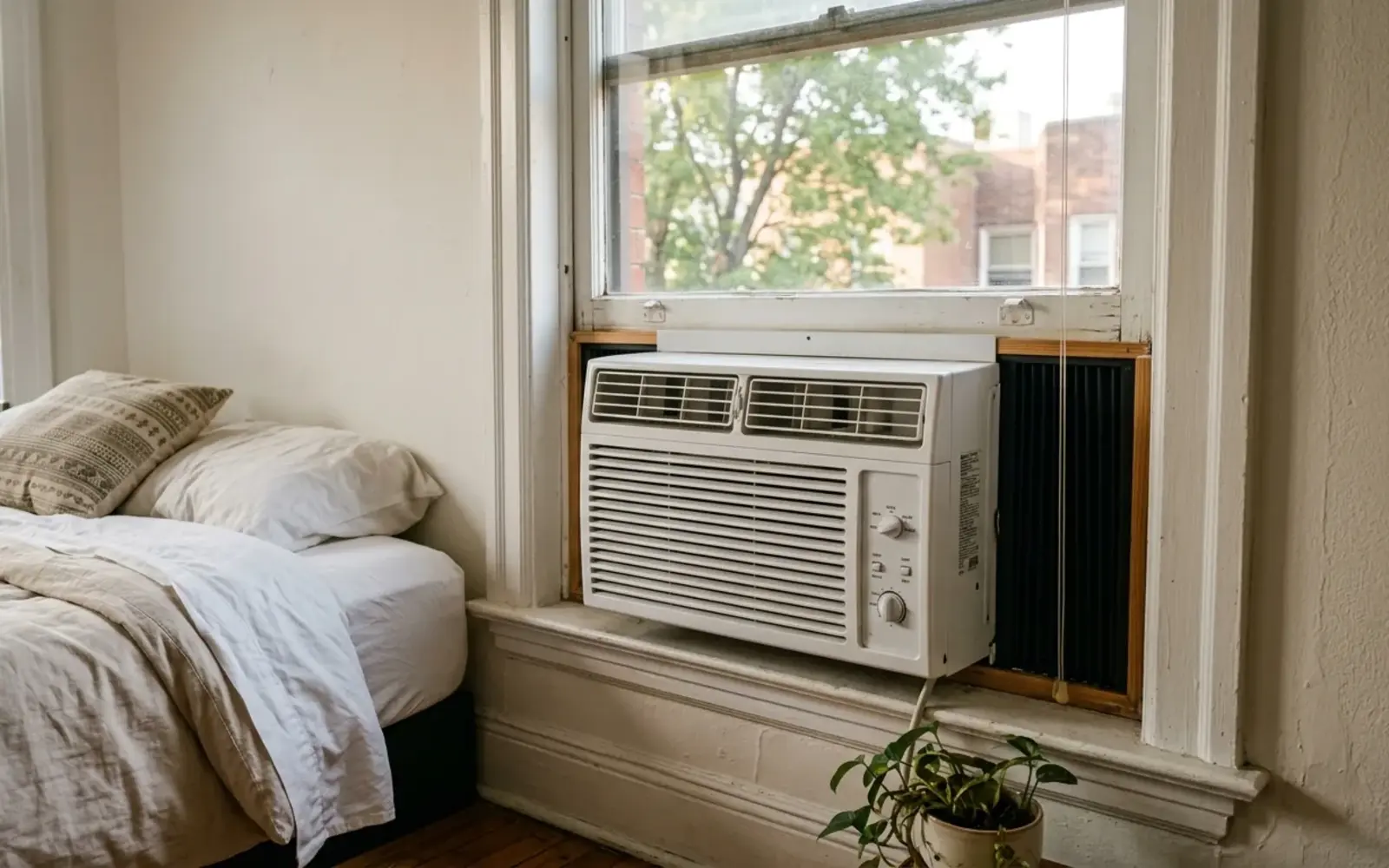
The short answer
If the window can take one, buy a window unit. It cools more per dollar and costs less to run than a portable of the same rating. Portable ACs lose capacity to the hose: a single-hose unit rated 12,000 BTU under the ASHRAE number can deliver only 7,000 to 8,000 BTU under the DOE's SACC rating, while a dual-hose unit holds 9,500 to 10,000. Expect roughly $190 to $200 for an 8,000 BTU window unit and $210 to $300 for a portable, checked August 2026. Buy a portable only when the window shape, the lease or the building rules genuinely rule out a window unit.
Most people comparing a window air conditioner with a portable one are comparing the wrong number. Both boxes carry a BTU rating on the front. Only one of them means what you think it means.
We do not sell air conditioners, and this page is not the site's main job. Our work is reading central AC replacement quotes, where the numbers run to five figures. But a lot of people arrive here asking a much smaller question first, and it deserves an honest answer rather than a nudge toward a system they do not need.
The short version
Buy a window unit if your window can take one. It cools more for the money, it costs less to run, and it is the only one of the two that ENERGY STAR certifies as a room air conditioner.
Buy a portable when something real stops you: a casement or sliding window that a window unit cannot seal, a lease or building rule that forbids them, or a room with no exterior window at all.
Why the portable loses capacity
A window unit sits in the wall of the room. The hot side is outside, the cold side is inside, and that is the whole design.
A portable sits on your floor. The entire machine, hot side included, is in the room with you, and a hose carries the heat out through a window kit. That creates two problems the box does not mention.
A single-hose portable takes the air it needs for cooling the condenser from the room it is cooling, then blows it outside. The room ends up at slightly negative pressure, so outside air gets pulled in around every door and window to replace it. You are paying to cool air that is being replaced by hot air as fast as you cool it.
Since 2017 the US Department of Energy has required two numbers on portable AC labels for this reason. The old ASHRAE figure is a laboratory number. The SACC figure, Seasonally Adjusted Cooling Capacity, accounts for the heat that leaks back in. The gap is not small: a single-hose unit rated 12,000 BTU under ASHRAE commonly delivers 7,000 to 8,000 BTU under SACC. A dual-hose unit, which draws its condenser air from outside instead of from your room, holds around 9,500 to 10,000.
Dual-hose portables also use roughly 20 to 40 percent less electricity than single-hose models at the same rating.
What to look at on the box
On a portable, read the SACC number and ignore the big one. If the listing only shows one BTU figure and it looks generous, it is the ASHRAE number. Sizing from it will leave you with a machine that runs constantly and never quite gets there.
Prefer dual-hose if you buy a portable at all. It is the difference between keeping most of your rated capacity and keeping half of it.
On a window unit, look for CEER and the ENERGY STAR mark. CEER is the combined efficiency ratio that room air conditioners are rated on, and ENERGY STAR's room air conditioner program covers window and through-wall units. The efficiency comparison between two window units is straightforward in a way the portable category is not.
Match the unit to the room, not to the house. Both types are room appliances. Neither is a small central system, and putting three of them in three rooms is usually more expensive to buy and to run than the alternatives.
What they cost
Checked August 2026, at the common sizes:
| 8,000 BTU | 12,000 BTU | |
|---|---|---|
| Window unit | about $187 to $200 | higher, varies by inverter or fixed-speed |
| Portable | about $209 | about $297 |
So the portable costs more up front, delivers less cooling per rated BTU, and uses more electricity doing it. That is three strikes, and it is why the honest recommendation is a window unit whenever the window allows one.
Prices move with the season. These are read from major US retailers in August 2026 and are a planning band, not a quote.
Which brands people actually buy
LG and Frigidaire are the two most searched names in this category, and both make competent window units. Friedrich sits above them on price and build, and is the one most often specified when a unit has to run hard for years rather than through one hot month. Midea's U-shaped inverter window unit is the design outlier worth knowing about: it straddles the sill so the window still closes over it, which changes the noise and security tradeoff that puts people off window units in the first place.
We do not rank these on our brand pages. Those pages exist for central system brands, where a buyer is holding a quote worth thousands and needs to know what the installer left out. A window unit is a purchase, not a project, and it does not come with a quote to check.
When a room unit is the wrong answer
Room units make sense for one or two rooms, for a rental, for a room the central system never quite reaches, or as a stopgap while you decide on something bigger.
They stop making sense when you find yourself buying a third one, when the rooms you are cooling are on more than one floor, or when you are running them all summer rather than through a heatwave. At that point the arithmetic starts favouring a proper system, and the questions change completely: sizing, ductwork, electrical capacity, and what a fair installed price looks like.
If that is where you have landed, start with what a central system actually costs and what the quote should contain. That is the part where the money is, and the part where we can genuinely help.
How this guide is checked
Written by Air Conditioner Guide Editorial Team. Editorial review by Air Conditioner Guide Editorial Team, last reviewed August 16, 2026. We check the sizing logic, quote-scope claims, and sources. No affiliate ranking bias.
Have a proposal?
Check the quote before you sign.
We'll look at the model match, capacity basis, install scope, warranty, and missing questions. Free, independent, no lead auction.
Check my quoteRelated guides

12 Air Conditioner Buying Mistakes to Avoid
Avoid the AC buying mistakes that create oversized equipment, missing scope, unverifiable efficiency, weak warranties, and expensive change orders.
Read the guide
AC Condensate Drain: Clogs, Traps, and Water Damage
Understand central AC condensate drains, pans, traps, pumps, overflow switches, clog symptoms, safe homeowner checks, and replacement-quote scope.
Read the guide
AC Electrical Safety: What Your Quote Should Cover
Understand the disconnect, breaker, and GFCI requirements a central AC replacement quote should include, and why the 2026 code deadline matters now.
Read the guide