The short answer
Short cycling means the compressor runs a few minutes, stops and restarts many times an hour, against 3 cycles per hour (about 10 minutes on, 10 off at half load) on Honeywell's recommended setting. Rule out the thermostat, filter, ice and condensate float switch first; a capacitor or contactor runs $100 to $450 and leak repair $200 to $1,500 or more (This Old House, 2026). If nothing is broken, test for oversizing: single-stage capacity should sit at 90 to 115 percent of the Manual J load, and an oversized unit leaves the house humid.
Short cycling is an air conditioner that runs a few minutes, shuts off and repeats that many times an hour. For scale, Honeywell's recommended compressor setting allows 3 cycles per hour, roughly 10 minutes on and 10 off at half load, with longer runs as the afternoon heats up. Rule out the thermostat, the filter, ice on the coil and a tripped condensate float switch first. If the system is healthy and still short cycles on hot days, compare its capacity with a Manual J load, because an oversized unit also leaves a cool house feeling damp.
Quick answer
| What you see | Likely cause | First move |
|---|---|---|
| Stops after a few minutes, ice on the copper line | Frozen coil from low airflow or low charge | Cooling off, check the filter, let it thaw |
| Hums or clicks, outdoor fan not spinning | Capacitor, contactor or compressor overload | Pro visit; capacitor $150 to $400 |
| Short runs on hot days, clammy at setpoint | Oversized equipment | Compare capacity with Manual J |
| Stops with a water alarm or wet pan | Condensate float switch tripped | Clear the drain; $80 to $250 |
| Erratic starts, thermostat in sun or over a register | Thermostat location or settings | Move or reconfigure it |
| Trips only on the hottest afternoons | High-pressure switch: dirty outdoor coil or failed fan | Pro visit; fan motor $300 to $800 |
| Returns after last year's recharge | Refrigerant leak | Leak search, not another top-off |
Prices are parts and labor from This Old House's AC repair cost guide, updated March 16, 2026: publisher ranges, not verified averages.
What normal cycling looks like
A single-stage compressor is either on at full output or off, so on any day cooler than the design day it has to cycle. What matters is how often it starts, how long each run lasts, and what ends the run.
| Reference point | Number | Source |
|---|---|---|
| Honeywell compressor cycle rate | 3 cycles per hour | Honeywell PRO TH2000DH guide |
| What 3 cycles per hour means | About 10 min on, 10 off at 50% load | Henderson, Shirey and Raustad, 2003 |
| Honeywell compressor protection | 5-minute off time | Same Honeywell guide |
| Copeland scroll compressor ceiling | 10 starts per hour | Copeland ZR KRE guidelines |
| Condensate delay on a dry coil | 12 to 33 min in lab tests | Shirey and Henderson, 2004 |
Honeywell's installer guide calls 3 cycles per hour "recommended for most compressors," with 1, 2, 4, 5 and 6 as the other options. Florida Solar Energy Center researchers describe 3 per hour as the normally assumed rate, equal to 10 minutes on and 10 off at 50 percent load. On hotter afternoons the runs stretch, and on a design day a correctly sized single-stage unit runs nearly continuously.
So there is no single normal cycle length. There are two tests:
- Who ends the run? If the thermostat reaches setpoint, the system is cycling on load. If the compressor stops while the thermostat still calls for cooling, a safety, control or electrical fault ended the run. That is never normal.
- How often does it start? On that setting, routinely more than about 3 starts an hour means something besides the thermostat's cycle logic is stopping the compressor. Near Copeland's 10 starts per hour, you are at the limit a compressor maker will stand behind.
Installers can lengthen runs: Advanced Energy's 2020 ecobee setup guidance for cooperative members with heat pumps recommends a 1.0°F cool differential and a 600-second minimum off time. That trades a wider temperature swing for fewer starts. It is not a repair.
A variable-speed outdoor unit ramps down instead of stopping, so a quieter unit is not a cycle. Check its control history before calling it short cycling.
How we built this guide
- Sources: Honeywell, Copeland and Rheem documents; ENERGY STAR's design report for the Manual S limits; ACCA, DOE, EPA and CDC; Florida Solar Energy Center and Building Science Corporation research. All checked October 16, 2026.
- Repair costs: This Old House (March 16 and April 7, 2026), Homewyse (January 2026), and Angi via This Old House plus Carrier for dehumidifiers. Named, dated publisher ranges, not verified averages.
- Replacement costs: our cost model, data version 2026-07-10, the one behind our 3-ton AC installed cost guide. Editorial planning bands, not a market survey.
- Worked examples are labeled illustrations with every assumption stated.
Causes of AC short cycling, ranked
We found no national data on which cause is most common, so this is the order to rule causes out: fastest and cheapest first.
| Cause | How it shows up | Who checks | Typical cost, 2026 |
|---|---|---|---|
| 1. Thermostat location or settings | Erratic starts; sensor in sun or over a register | You, then a pro | $0 to adjust; $100 to $500 to replace |
| 2. Dirty filter | Loaded media, weak airflow | You | The price of a filter |
| 3. Frozen evaporator coil | Ice on the coil or suction line | You spot it, a pro finds why | Coil cleaning $182 to $464 |
| 4. Clogged drain, float switch tripped | Water in the pan, stops mid-call | You look, a pro clears it | Drain line $80 to $250; pan $200 to $800 |
| 5. Bad capacitor or contactor | Hum, click, fan stalls, compressor overload | Pro only | Capacitor $150 to $400; contactor $100 to $450 |
| 6. Pressure switch trips | Stops on hot afternoons, or with ice | Pro only | Diagnosis $75 to $150, then the cause |
| 7. Low refrigerant from a leak | Weak cooling, ice, low-pressure trips | Pro only | Leak repair $200 to $1,500 or more |
| 8. Electrical faults | Breaker trips, burned wiring, board resets | Pro only | Circuit board $200 to $800 |
| 9. Oversized equipment | Short runs on hot days, nothing broken | Pro with a Manual J | $0 in settings to a new system |
Repair and diagnosis figures: This Old House, March 16, 2026. Coil cleaning: Homewyse, January 2026.
What to know about each:
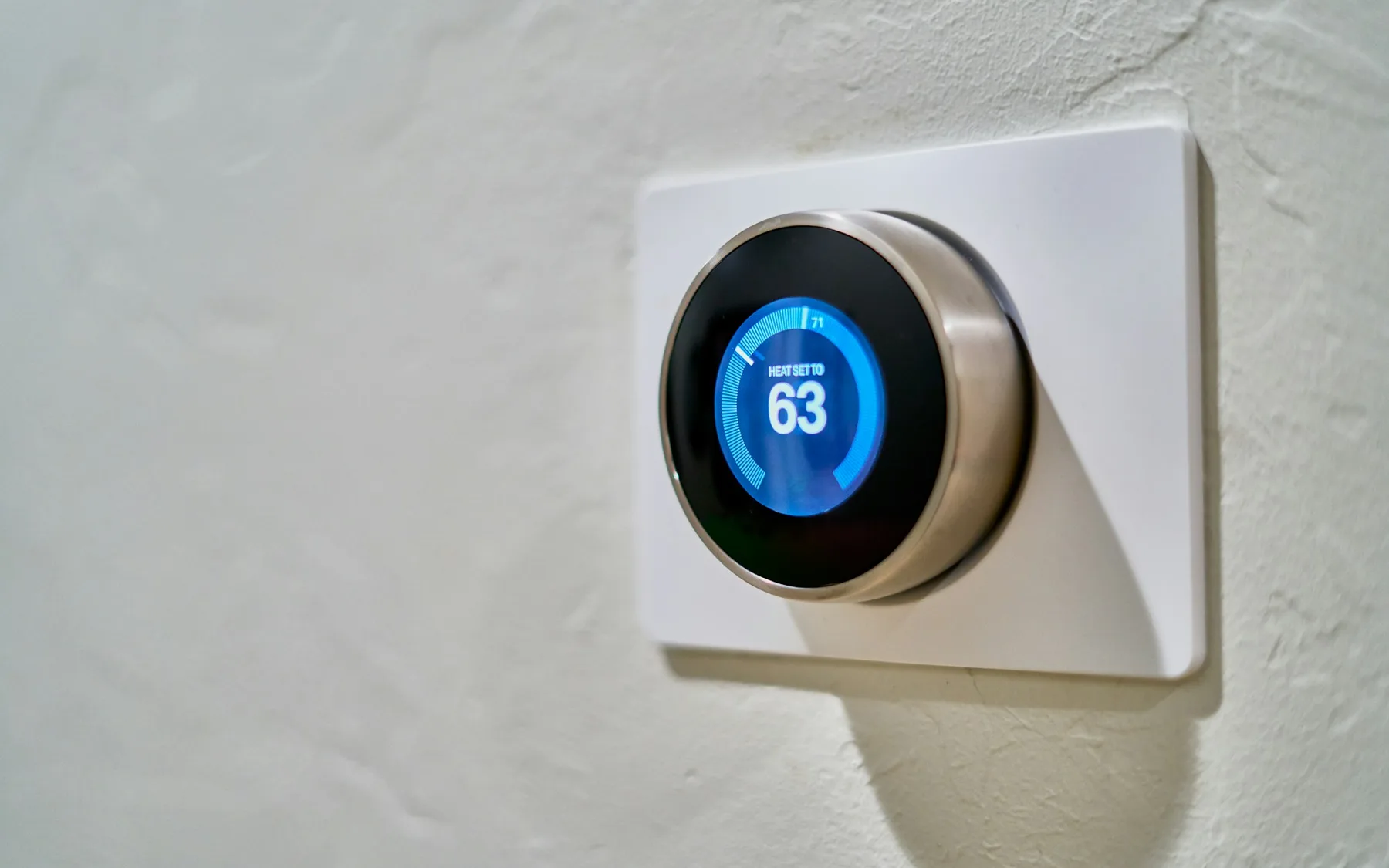
- Thermostat. It measures the air around it. Resideo's rules for its Honeywell Home sensors: about 5 feet up, on an inside wall, out of direct sunlight, not above an air vent. A cycle rate of 5 or 6 per hour also shortens runs.
- Filter and frozen coil. ENERGY STAR advises inspecting filters monthly and puts the efficiency loss from airflow problems at up to 15 percent. Low airflow lets the coil freeze. A frozen coil usually makes a system run long and weak; it short cycles when a low-pressure switch or freeze sensor stops the compressor and lets it restart. See our filter interval guide.
- Float switch. A clogged drain lifts the float, cooling stops, the water drains down, cooling restarts. ENERGY STAR notes a plugged drain can cause water damage and affect indoor humidity. Never jumper the switch. Our condensate drain guide covers safe cleaning.
- Capacitor, contactor, pressure switches, wiring. A weak capacitor can let the compressor overheat and trip its internal overload. A high-pressure switch opens when the outdoor coil is matted, the condenser fan fails or the system is overcharged; a low-pressure switch opens on low charge or low indoor airflow. Restart and lockout behavior varies by manufacturer. All of this is work for a licensed technician.
- Refrigerant. Unless it was undercharged at installation, a system that is low has a leak. This Old House puts a central AC recharge at $150 to $600, with R-410A at $50 to $80 per pound installed (April 7, 2026). Refrigerant work requires an EPA Section 608 certified technician. Read our refrigerant leak guide before approving a top-off.
- Zoning. When one small zone calls, a bypass duct can send cold air straight back to the return until a safety trips.
The 10-minute homeowner check
None of these steps requires opening an electrical panel.
- Thermostat. Mode on Cool, fan on AUTO, fresh batteries. Note any sun, lamp or supply register near it.
- Filter. Hold it to a light. If you cannot see through most of it, replace it with the exact size, arrow toward the blower.
- Registers. Supply and return grilles open and unblocked.
- Indoor unit. With a flashlight, look for ice on the copper lines, water in the secondary pan, a float switch sitting in water.
- Outdoor unit. The top fan should spin whenever the compressor runs. Clear leaves and clutter.
- Breaker. Reset a tripped AC breaker once. If it trips again, leave it off.
- Start a log. For the next hour, note when the outdoor unit starts and stops, the outdoor temperature, and whether the thermostat had reached setpoint at each stop.
That log answers the first diagnostic question, who ended the run, before anyone opens a panel.
When to stop and call a pro
Turn cooling off and book service for ice that returns after a new filter and a full thaw, water near any electrical part, a breaker that trips twice, a burning smell, a buzzing outdoor unit with a stalled fan, oily residue on refrigerant joints, or short cycling that survives every check above. A tripping safety means something is already wrong.
Signs your AC is oversized
An oversized air conditioner cools the air around the thermostat fast and stops before the house reaches a stable temperature and humidity. The signs:
- Runs last only a few minutes even on hot afternoons.
- The thermostat is satisfied while distant rooms stay warm.
- Humidity stays high when the temperature is low.
- The house swings between too cold and too warm.
- Installed capacity sits well above a room-by-room load calculation.
Only the fifth is proof. The others have look-alikes:
| Symptom | Other possible cause |
|---|---|
| Short cycles | Thermostat location, safety switch, frozen coil, electrical fault |
| High humidity | Fan set to ON, duct leaks, airflow setup, charge, clogged drain |
| Uneven rooms | Duct leakage, poor balancing, solar gain, closed registers |
| Temperature swings | Thermostat differential, sensor location, zoning setup |
The oversizing test: capacity divided by load
Take the system's total cooling capacity at your design conditions, from the manufacturer's expanded performance data for the exact indoor and outdoor match, and divide it by the total load from a room-by-room Manual J. ENERGY STAR's HVAC design report publishes the Manual S limits:
| Compressor type | Recommended range | ENERGY STAR temporary allowance |
|---|---|---|
| Single-speed | 90 to 115% | 90 to 130% |
| Two-speed | 90 to 120% | 90 to 140% |
| Variable-speed | 90 to 130% | 90 to 160% |
| Heat pump, Condition B climate | 90 to 100%, plus 15,000 Btu/h | Same |
The recommended column is the Manual S second edition. ENERGY STAR's Rev. 13 report selects equipment per Manual S "except that cooling ranges above ACCA Manual S limits are temporarily allowed," which is the right-hand column. Condition B means a dry, heating-dominated location: a load sensible heat ratio of at least 95 percent and a heating-to-cooling degree-day ratio of at least 2.0. ACCA's 2014 article on that edition confirms the lower limit moved from 0.95 to 0.90 of the cooling load.
Two details keep the test accurate. Use delivered capacity, not the nameplate: a nominal ton is 12,000 Btu/h, but design-day output depends on the match, and ENERGY STAR's 2025 supplement lists variable-speed capacity at the AHRI rating speed. And use a real load, not square feet; our Manual J guide shows what the report contains and what size AC you need covers the inputs. For spaces with a cooling load of 15,000 Btu/h or less, ENERGY STAR allows single-speed equipment up to 20,000 Btu/h.
Oversizing is common: a 1997 Florida Solar Energy Center study of 368 recently built Florida homes found more than half had cooling capacity above 120 percent of the Manual J value, with higher peak energy use above that line.
Settings can soften the symptoms but not the capacity: fan on AUTO, a shorter blower-off delay, a dehumidify airflow mode, a better thermostat location, the low stage on two-stage equipment. Never slow airflow below the manufacturer's approved limits to chill the coil; that can freeze it and cut capacity. Variable-speed systems can be oversized too, because every model has a minimum output.
AC running but not removing humidity
An air conditioner lowers temperature (sensible cooling) and condenses water out of the air on the indoor coil (latent cooling). Rheem's installation instructions for its H1V and H2V air handlers put typical latent capacity at 23 to 25 percent of total capacity. The catch is time:
- Condensate took 12 to 33 minutes to first drip from dry coils at standard rating conditions in Florida Solar Energy Center lab tests (Shirey and Henderson, ASHRAE Journal, April 2004). Most coils held 8 to 9 pounds of water per 1,000 square feet of fin area before draining.
- Humid air shortens the wait. For one coil it fell from 40 minutes at a 50°F entering dew point to 10 minutes at 70°F.
- When the compressor stops, a running blower evaporates the coil's water back into the house.
A 7-minute run on a dry coil sends little or no water down the drain. The same research found that oversizing increases the time at part load and results in higher indoor humidity.
How much is too much? EPA advises keeping indoor relative humidity below 60 percent, ideally 30 to 50 percent (updated February 18, 2026). CDC says no higher than 50 percent and names an air conditioner or dehumidifier as the tool. Log a hygrometer reading away from kitchens, baths and supply registers for several days before acting.
| Cause | What you notice | Fix |
|---|---|---|
| Oversized equipment | Short runs on hot days | Settings now, right-size later |
| Fan set to ON | Fan runs between cycles | Switch to AUTO |
| Long blower-off delay | Fan runs on after each cycle | Shorten the delay |
| Airflow set too high | Cool but sticky | Reset to the manufacturer's table |
| Low charge or dirty coil | Weak cooling, possible ice | Technician measurement |
| Duct or house air leaks | Humidity tracks the weather | Seal and test |
| Clogged condensate drain | Water in the pan, float alarm | Clear and trap the drain |
Fan ON is the easiest cause to fix. One field-measured system with a continuously running fan removed no net moisture when the compressor ran less than 40 percent of the time. AUTO fan mode showed the same loss "to much lesser extent." The researchers cited a utility study finding only 2 percent of Florida homeowners ran the fan continuously.
| Fix | Typical cost | What it does |
|---|---|---|
| Fan to AUTO | $0 | Stops re-evaporating coil water |
| Shorter blower-off delay | A $75 to $150 visit | Less water blown back after each run |
| Dehumidify airflow mode | Same visit, if supported | Colder coil, more latent removal |
| Whole-house dehumidifier | $1,300 to $2,800 installed | Removes moisture without overcooling |
| Right-size at replacement | 2.5-ton system from $5,500 | Longer runs every summer day |
| Two-stage or variable-speed | Adds $1,200 to $7,000 | Long low-speed runs at part load |
Dehumidifier: Angi via This Old House (May 26, 2026); Carrier's guide says $1,000 to $2,800 with installation. Replacement: our cost model, where the better tier adds $1,200 to $3,000 and premium variable-capacity adds $3,500 to $7,000. Visit fee: This Old House.
Rheem's H1V and H2V air handlers ship with a 30-second blower-off delay and an "On Demand Dehumidification" input that lowers airflow when humidity exceeds the setting. A DOE-funded Home Innovation Research Labs project held humidity "well below goals" in a hot-humid climate using modified controls and lower airflows on conventional equipment. After any airflow change, recheck charge and airflow, as Rheem's manual warns.
What short cycling costs you
Wear: the starts math
Copeland's guidelines for its ZR KRE comfort scroll compressors recommend at most 10 starts per hour. The limit is oil: each run must last long enough for oil thrown out at startup to return, and shorter cycling "will result in progressive loss of oil and damage to the compressor."
Assume 10 cycling hours a day for 150 days, 1,500 hours a year. These are our assumptions; change them for your climate.
| Pattern | Starts per hour | Starts per year | Over 15 years |
|---|---|---|---|
| Honeywell recommended rate | 3 | 4,500 | 67,500 |
| Moderate short cycling | 6 | 9,000 | 135,000 |
| Safety trip: 3 min on, 5 off | 7.5 | 11,250 | 168,750 |
| Copeland's stated ceiling | 10 | 15,000 | 225,000 |
The 3-per-hour row is close to a worst case for a healthy single-stage system, since that rate peaks at 50 percent load. We found no study that converts extra starts into lost compressor years. ENERGY STAR warns that oversized equipment may cycle too frequently, "resulting in less comfort and a shortened lifespan."
Energy: smaller than you might think
| Study | What changed | Energy result |
|---|---|---|
| FSEC, Florida, 1997 | Capacity cut from 150% to 120% of design load | 5.6% less energy |
| Sonne, Florida, 2006 | Smaller units in 4 houses | 2 to 3% with ducts inside; negligible in attics |
| Building Science Corp., Redding CA, 2008 | 155 to 185% resized to 135 to 150% | Same energy, longer runs, lower peak demand |
| SEER rating procedure, 2008 | Cycling loss coefficient CD | Default 0.25; most modern units 0.05 to 0.10 |
The first two results and the CD figures are as summarized by Townsend and Ueno of Building Science Corporation in their 2008 ACEEE paper. Power draw reaches near steady state within seconds of a start, while cooling output takes a few minutes, which is the cycling loss. Sonne and colleagues suggested lower cycling losses in newer equipment explain why their savings came in below the 1997 figure. If cooling costs you $1,200 a year, 5.6 percent is about $67. The bigger costs of oversizing are humidity, comfort, purchase price and wear.
When it justifies replacement
Fault-driven short cycling almost never does: filter, thermostat, float switch, capacitor and contactor fixes cost a few hundred dollars at most. Oversizing alone rarely justifies removing a young, reliable system either, when settings and a $1,300 to $2,800 dehumidifier can fix the humidity. Replace when the system is due anyway, such as a compressor or coil failure on an older unit or a repair near half the cost of a correctly scoped replacement, the rule of thumb in our repair or replace guide. Then the right-sized system is often the cheaper one.
Worked example 1: a 4-ton unit on a 2.5-ton load in Florida
Illustration. Every input below is an assumption.
A Florida home has a 4-ton single-stage system, fan on ON, and feels clammy at 75°F. A room-by-room Manual J puts the total cooling load at 30,000 Btu/h, 2.5 tons. Assume the unit delivers its nominal 48,000 Btu/h at design conditions.
| Step | 4-ton installed | 2.5-ton right-sized |
|---|---|---|
| Capacity divided by load | 160% | 100% |
| Within the 115% limit? | No, and above 130% | Yes |
| Running share, design day | 62.5% | 100% |
| Running share, 60%-load day | 37.5% | 60% |
| Average run at 3 cycles per hour | 7.5 minutes | 12 minutes |
| Standard-tier replacement band | $7,500 to $12,500 | $5,500 to $8,800 |
Running share is load divided by capacity: 18,000 / 48,000 = 37.5 percent. At 3 starts an hour, each run averages 37.5 percent of 60 minutes divided by 3, or 7.5 minutes. The 115 percent limit caps capacity for this house at 34,500 Btu/h.
A 7.5-minute run is shorter than the 12 to 33 minutes the lab coils needed to start draining, and with the fan on ON, 37.5 percent runtime sits where that field-measured system removed no net moisture. Fixes, cheapest first: fan to AUTO for $0; a shorter blower-off delay and dehumidify mode on a $75 to $150 visit; a $1,300 to $2,800 dehumidifier if humidity stays above 50 to 60 percent. At replacement, buy 2.5 tons: on our bands that costs $2,000 to $3,700 less than another 4-ton. Run your own house through the AC sizing and cost calculator.
Worked example 2: a right-sized unit short cycling on a frozen coil
Illustration. Every input below is an assumption.
A 3-ton system delivering 36,000 Btu/h serves a 34,000 Btu/h Manual J load, a 106 percent ratio inside the 115 percent limit. In July it starts stopping after about 3 minutes and restarting 5 minutes later while the thermostat keeps calling. The 1-inch filter has not been changed since March.
The loaded filter cut airflow, the coil froze, suction pressure fell, and the low-pressure switch opened. When pressure recovered, the switch closed and the thermostat's 5-minute protection let the compressor restart: 7.5 starts an hour, near Copeland's ceiling of 10.
| Step | Who | Cost |
|---|---|---|
| Cooling off, let the coil thaw fully | You | $0 |
| Watch the pan and drain as ice melts | You | $0 |
| New filter, exact size | You | The filter |
| Restart and time the runs for an hour | You | $0 |
| If ice returns: coil cleaning | Technician | $182 to $464 |
| If the pan overflowed: drain cleaning | Technician | $80 to $250 |
| Visit to check blower, charge and coil | Technician | $75 to $150 |
If the new filter fixes it, the repair cost a filter. If ice returns, the worst case here is $337 to $864 before any refrigerant work. A second freeze with a clean filter and clean coil points to low charge or a blower fault, where the $200 to $1,500 leak repair range comes in. This house does not need a bigger air conditioner.
Contractor red flags
- A recharge with no leak search. A system that is low has a leak.
- "A bigger unit will fix it." More capacity makes short runs shorter.
- No Manual J at replacement. Copying the old nameplate repeats the last installer's guess.
- Jumpering a float or pressure switch to restore cooling.
- A new system quoted for a failed capacitor or contactor with no written diagnosis of anything else.
- Airflow turned below the manufacturer's table with no static pressure or charge readings afterward.
- A cycle-rate change sold as the fix for a system tripping on a safety.
If a proposal includes any of these, send it for an independent quote review before you sign. For the replacement itself, our staging comparison shows what each compressor type does at part load.
FAQ
How long should an AC run per cycle?
It depends on the weather. On Honeywell's recommended setting of 3 cycles per hour, a single-stage AC runs about 10 minutes on and 10 off at half load, according to Florida Solar Energy Center researchers, and longer as the day heats up. On a design-temperature afternoon a correctly sized unit runs almost continuously. Runs of a few minutes, repeated many times an hour on a hot day, are short cycling.
Is it bad if my AC turns on and off every 5 minutes?
Yes, if it continues hour after hour. That is 6 to 12 starts an hour, above the 3 Honeywell recommends and close to Copeland's maximum of 10 for its scroll compressors. Check the filter, thermostat, ice and float switch, then have a technician find out whether a safety switch is ending the runs.
How do I know if my AC is oversized?
Divide the system's cooling capacity at your design temperature by the total load from a room-by-room Manual J. ENERGY STAR's Manual S table recommends 90 to 115 percent for single-speed equipment, 90 to 120 percent for two-speed and 90 to 130 percent for variable-speed. Short runs on hot days and a clammy house are clues; only the calculation proves it.
Why is my AC running but not removing humidity?
Usually the runs are too short or the fan is set to ON. Lab coils took 12 to 33 minutes to start dripping from dry, so short cycles remove little water, and a fan that keeps running blows the coil's water back into the house. Set the fan to AUTO, aim for 30 to 50 percent humidity as EPA advises, and check for oversizing, airflow, charge, duct leaks and a clogged drain.
Should the AC fan be on AUTO or ON in humid weather?
AUTO. In the Florida Solar Energy Center research, continuous fan operation caused the largest loss of moisture removal at part load, and one field system on ON removed no net moisture when the compressor ran less than 40 percent of the time. AUTO still loses some moisture after each cycle, but much less.
Can a dirty filter cause short cycling?
Yes. A loaded filter cuts airflow, the coil can freeze, and a low-pressure switch or freeze sensor may then stop and restart the compressor in short runs. Replace the filter, let the ice thaw completely, and book service if the ice or the short cycling returns.
What we could not verify
- Which cause is most common. We found no national data, so our ranking is a check order.
- The 2023 Manual S limits. ACCA's current edition is ANSI/ACCA 3 Manual S-2023 with two 2024 addenda. Our table comes from ENERGY STAR's report, which cites the second edition; we could not confirm whether the 2023 edition changed the cooling limits.
- ecobee factory defaults. We could not read ecobee's own documentation for its default minimum off time or cool differential. The 600-second and 1.0°F figures are a utility program's recommendation.
- Compressor life per start. No study we found converts starts into lost years. Copeland's 10-start limit is for its ZR KRE comfort range; other compressor lines may differ.
- Some repair prices. We found no dated source we trust for replacing a pressure switch or float switch, or for moving a thermostat.
- Pressure switch setpoints and lockout counts, which vary by manufacturer and model.
- Study age. The energy results date from 1997 to 2008 and the coil data from 2003 to 2004. Equipment has improved since.
Sources
All sources checked October 16, 2026.
- Honeywell (Resideo): PRO TH2000DH/TH1000DH installation guide, 69-2609EFS
- Henderson, Shirey and Raustad: Understanding the Dehumidification Performance of Air-Conditioning Equipment at Part-Load Conditions, CIBSE/ASHRAE 2003
- Shirey and Henderson: Dehumidification at Part Load, ASHRAE Journal, April 2004 (FSEC-GP-151-06)
- Copeland: Application guidelines, scroll compressors for comfort applications, ZR24KRE to ZR190KRE
- ENERGY STAR: National HVAC Design Report, Rev. 13, revised February 1, 2024
- ENERGY STAR: National HVAC Design Supplement to Std. 310, Rev. 14, revised January 15, 2025
- ACCA: Manual S Residential Equipment Selection
- ACCA: Evolving Industry, Revised Standard, May 26, 2014
- Florida Solar Energy Center: The Effect of Residential Equipment Capacity on Energy Use, Demand, and Run-Time, 1997
- Townsend and Ueno, Building Science Corporation: Effects of Air Conditioner Sizing on Energy Consumption and Peak Demand in a Hot-Dry Climate, ACEEE 2008
- ENERGY STAR: HVAC Quality Installation
- ENERGY STAR: Maintenance Checklist
- DOE: HVAC Sizing Research
- DOE: Advanced HVAC Humidity Control for Hot-Humid Climates
- Rheem: H1V and H2V air handler installation instructions, 92-20521-65-07
- Resideo: Wireless room sensors for T9 and T10 Pro thermostats, placement tips
- Advanced Energy via Berkeley Electric Cooperative: ecobee thermostat setup guidelines, 2020
- EPA: A Brief Guide to Mold, Moisture and Your Home
- CDC: About Mold
- EPA: Section 608 Technician Certification
- This Old House: AC repair cost guide, updated March 16, 2026
- This Old House: How much does Freon cost, updated April 7, 2026
- This Old House: How to install a whole-house dehumidifier, updated May 26, 2026
- Carrier: Whole-house dehumidifier cost
- Homewyse: Cost to clean an evaporator coil, January 2026
How this guide is checked
Written by Air Conditioner Guide Editorial Team. Editorial review by Air Conditioner Guide Editorial Team, last reviewed October 16, 2026. We check the sizing logic, quote-scope claims, and sources. No affiliate ranking bias.
Have a proposal?
Check the quote before you sign.
We'll look at the model match, capacity basis, install scope, warranty, and missing questions. Free, independent, no lead auction.
Check my quoteRelated guides
AC Refrigerant Leak: Signs and Repair Cost in 2026
AC refrigerant leak signs, 2026 repair costs by leak location, refrigerant prices per pound, the EPA rules, and when replacing the system beats a repair.
Read the guide
What Size AC Do I Need? 2026 Sizing Chart and Manual J Check
Screening AC tonnage by home size and climate for 2026, why square footage alone fails, and how Manual J and Manual S set the final size.
Read the guide
Central Air Conditioner Cost 2026: Prices by Size and Tier
Central AC costs $4,500 to $14,500 installed at standard tier for 1.5 to 5 tons in 2026. Prices by size, tier, home size, ducts and running cost.
Read the guide