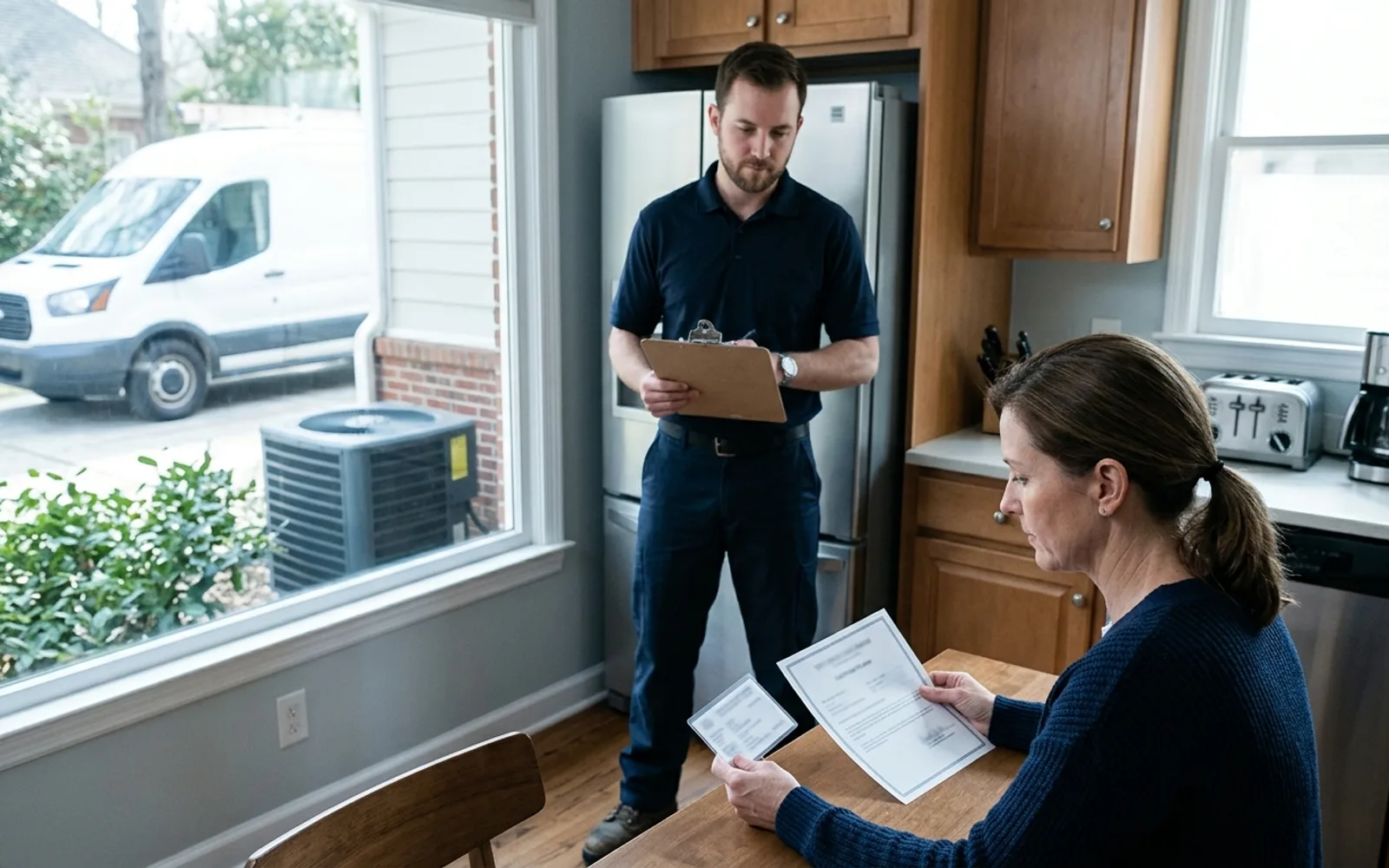
The short answer
Before you sign or pay a deposit, verify four things about the contractor, not just the quote: an active license in your state's own lookup tool, a certificate of insurance naming general liability and workers' compensation, EPA Section 608 certification for whoever handles refrigerant, and a written change-order clause that requires your signature before extra work starts. A deposit above what your state allows, pressure to sign today, or a refusal to put any of this in writing is the red flag, not the price.
Vetting the contractor is a separate job from vetting the quote. A proposal can list the correct equipment, tonnage, and duct scope and still come from a business that is not actually licensed in your state, carries no insurance, or expects a deposit well above what your state allows. Before you sign anything or hand over money, confirm four things directly: the license is active in your state's own lookup tool, the certificate of insurance names general liability and workers' compensation, anyone handling refrigerant holds EPA Section 608 certification, and the contract requires your written signature before any change order starts.
This page does not repeat the scope checks already covered in how to compare AC quotes and 12 AC buying mistakes, which walk through model numbers, AHRI matching, sizing, ducts, line-set work, and warranty layers. This page is about the contractor and the transaction: license, insurance, certification, deposit, and change orders.
Red flags and what they actually predict
| Red flag | What it predicts | What to verify instead | Where it becomes a walk-away |
|---|---|---|---|
| Contractor cannot produce a license number, or the number does not match an active record | Unlicensed work, no recourse if the job fails, no state consumer-protection backstop | Look the license up yourself in your state's official database, described below | No active, matching license record: walk away |
| No certificate of insurance, or one that does not name general liability and workers' compensation | You could be liable for a jobsite injury or property damage the business cannot cover | Ask for a certificate of insurance naming both coverages and, where required, your state licensing board as certificate holder | Refusal to produce a certificate naming both coverages |
| Refrigerant work with no mention of EPA Section 608 certification | Improper refrigerant handling, a federal compliance problem, and a technician who may not be trained on the equipment's requirements | Ask which technician on the job holds Section 608 certification and for which equipment type | No one on the job claims certification |
| Deposit at or near the full contract price, or demanded before a signed contract | A business financing its operations from customer deposits, or one that will not still be there for warranty service | Confirm your state's deposit rules; two examples are below | A deposit that exceeds your state's cap, or any payment demanded before the contract is signed |
| "Sign today" pricing, in-home pressure, or "leftover materials from another job" | A sales tactic timed to prevent comparison shopping, not a real one-day price | Ask for the same quote in writing with 48 hours to review it | Refusal to leave a written quote without a same-day signature |
| No written change-order process, or a verbal promise to "true up" the price later | Uncapped extra charges once work has started and you have less leverage | Require a written, signed change order before any extra work begins, described below | Contract silent on change orders, or a verbal "we'll figure it out" answer |
| Contractor steers you to their own preferred lender before the scope is finalized | Financing signed against an incomplete or inflated scope | Get the final written scope first, then shop financing separately | Financing paperwork presented before the scope is complete |
Verify the license yourself
Do not accept a photo of a license card at face value. Confirm it in your state's own database, which is free and typically takes a few minutes.
- Search for "[your state] contractor license lookup" or "[your state] HVAC license verification" and confirm the site is a
.govdomain or your state's official licensing board. - Search by the license number if you have it, or by the business or individual's name.
- Confirm the license is active, covers HVAC or air-conditioning work specifically, and check for any disciplinary history.
Two live examples, checked for this page on 2026-09-06:
- California: the Contractors State License Board's public license lookup searches by license number, business name, or individual name and shows license status and complaint disclosure.
- Texas: the Texas Department of Licensing and Regulation's license search covers Air Conditioning Contractor (ACR) licenses by number or name; the underlying database is updated daily.
If your state's board does not publish an online search, call the board directly and ask them to confirm the license and its status while you wait.
Confirm the insurance, not just the license
A license and insurance are two different protections. A certificate of insurance (COI) should name:
- General liability insurance, covering property damage or injury the contractor's work causes to your home.
- Workers' compensation insurance, covering an injury to one of the contractor's own employees on your property. Without it, an injured worker could have grounds to pursue you directly.
Insurance rules vary by state and by trade classification. California is a concrete example of how specific these rules get: the state's C-20 classification, which covers warm-air heating, ventilating, and air-conditioning contractors, is one of a short list of trades required to carry workers' compensation insurance (or a certified self-insurance filing) whether or not the business has any employees. California's Contractors State License Board states that a compliant certificate must show the business name and license number, the policy number, effective and expiration dates, and an authorized insurer's signature. Ask for the same level of detail regardless of your state, and confirm the policy dates have not lapsed.
EPA Section 608: the certification refrigerant work actually requires
Under Section 608 of the Clean Air Act, anyone who maintains, services, repairs, or disposes of equipment containing regulated refrigerant must hold EPA Section 608 Technician Certification. The EPA defines four certification types: Type I for small appliances, Type II for high- and very-high-pressure equipment, which covers most residential and light-commercial air conditioners, Type III for low-pressure equipment, and Universal, which covers all three. The certification does not expire once earned.
Ask which technician on the job is Section 608 certified and for which type. There is no public consumer lookup tool to check a specific technician's certification status; asking to see the certification card or documentation directly is the practical check available to a homeowner.
Refrigerant certification is a separate question from which refrigerant your new system uses. Our R-454B vs R-410A guide covers what to verify about the refrigerant itself once the contractor's certification checks out.
Deposits, pressure tactics, and your right to cancel
There is no single national deposit limit, but several states cap how much a contractor can collect upfront on a home improvement contract. Two examples, checked for this page on 2026-09-06:
| State | Deposit rule | Source |
|---|---|---|
| California | No more than 10% of the contract price or $1,000, whichever is less | Cal. Business & Professions Code Section 7159.5, via the Contractors State License Board |
| Maryland | No more than one-third of the contract price, and no payment at all before the contract is signed | Maryland Home Improvement Law, administered by the Maryland Home Improvement Commission |
Check your own state's rule with your state licensing board or attorney general's consumer-protection office before agreeing to a deposit. The FTC's own guidance on home-improvement scams is blunt: do not pay the full project cost upfront, and some states limit the deposit percentage a contractor can request.
The FTC also names specific pressure tactics to watch for: a contractor who showed up unsolicited claiming to be "in the area," an offer built on "leftover materials" from another job, pressure for an immediate decision, a demand for full payment upfront or cash-only payment, a contractor who asks you to pull the required permit yourself, and steering toward the contractor's own preferred lender before the scope is finalized.
If a contractor signs you up in your home, rather than at their place of business, federal law gives you a real cancellation window. The FTC's Cooling-Off Rule (16 CFR Part 429) gives consumers the right to cancel a sale of $25 or more, made at home or away from the seller's regular place of business, without penalty, any time before midnight of the third business day after signing. The seller is required to give you two copies of a cancellation form and disclose this right in writing at the time of sale. If that disclosure did not happen, that is itself a red flag independent of anything else in the contract.
Change orders: get the process in writing before you need it
A quote that looks complete on day one can still turn into an open-ended bill once work starts, if the contract does not say what happens when the scope changes. California's contractor law is a useful model for the language to request in any state: a change order for extra work becomes part of the contract only if it is in writing and signed by both parties before the change-order work begins. Ask your contractor, wherever you live, to agree to the same standard in writing:
- No extra work starts without a written change order.
- The change order states the added scope and the added price before work begins.
- You sign the change order. A verbal go-ahead, or your silence, does not count as approval.
A contractor unwilling to commit to that process in writing is telling you how a mid-project price increase will likely go.
Once the contractor checks out, check my quote puts the equipment scope itself through an independent review before you sign.
What we could not verify
- No national deposit cap. California and Maryland are named as two real, sourced examples. Most states set their own rule, and some set none; confirm yours directly rather than assuming either example applies.
- No consumer-facing tool to verify a specific technician's EPA Section 608 certification status. The certification requirement itself is federal and verifiable in principle, but no public lookup exists for an individual technician's record. Ask to see the documentation directly.
- No verified deposit-cap figure for states beyond the two named here. Other figures appear on non-government aggregator sites but could not be confirmed against a primary state source for this page, so they are not included.
Frequently Asked Questions
How do I verify an HVAC contractor's license?
Search your state's official licensing board site, usually a .gov domain, and use its license lookup tool with the license number, business name, or individual's name. Confirm the license is active, covers HVAC or air-conditioning work, and check for disciplinary history. California's Contractors State License Board and Texas's Department of Licensing and Regulation both publish free public lookup tools as examples of what to expect.
What insurance should an HVAC contractor carry?
At minimum, ask for a certificate of insurance naming general liability coverage and workers' compensation coverage, with the business name, license number, policy number, and effective dates shown. Some states require certain HVAC classifications to carry workers' compensation regardless of whether the business has employees, so do not assume a small crew is exempt.
Is it normal to pay a deposit before AC installation starts?
A modest deposit can be normal, but the size varies by state, and some states cap it by law. California caps it at 10% of the contract price or $1,000, whichever is less. Maryland caps it at one-third of the contract price and bars any payment before the contract is signed. Confirm your own state's rule before agreeing to a number.
What is EPA Section 608 certification and why does it matter?
It is a federal certification required for anyone who handles regulated refrigerant during service, repair, or disposal of air-conditioning equipment. It does not expire once earned. Ask which technician on your job holds it, since there is no public lookup to verify it yourself.
Can I cancel an HVAC contract after I sign it?
If you signed the contract in your home, or somewhere other than the contractor's regular place of business, the FTC's Cooling-Off Rule gives you until midnight of the third business day to cancel without penalty. The seller must give you written notice of this right and a cancellation form at the time of signing.
What should a change order for extra AC work include?
It should be written, describe the added scope and added price, and require your signature before the extra work begins. A verbal promise to "true up" the price later, or work that starts before you approve the change in writing, removes your ability to dispute the charge afterward.
Sources
- EPA: Section 608 Technician Certification
- EPA: Section 608 Technician Certification Requirements
- California CSLB: What Is a Home Improvement Contract
- California CSLB: Workers' Compensation Requirements
- California CSLB: Check a License
- California Business and Professions Code Section 7159 (change orders)
- California Business and Professions Code Section 7159.5 (down payment cap)
- Maryland Home Improvement Commission: Home Improvement Contracts
- Texas Department of Licensing and Regulation: License Search
- FTC: Cooling-Off Rule
- FTC: How To Avoid a Home Improvement Scam
- ACCA: Homeowner Guidance
How this guide is checked
Written by Air Conditioner Guide Editorial Team. Editorial review by Air Conditioner Guide Editorial Team, last reviewed September 6, 2026. We check the sizing logic, quote-scope claims, and sources. No affiliate ranking bias.
Have a proposal?
Check the quote before you sign.
We'll look at the model match, capacity basis, install scope, warranty, and missing questions. Free, independent, no lead auction.
Check my quoteRelated guides
12 Air Conditioner Buying Mistakes to Avoid
Avoid the AC buying mistakes that create oversized equipment, missing scope, unverifiable efficiency, weak warranties, and expensive change orders.
Read the guide
Central Air Conditioner Cost: The Installed Price
A central AC replacement is more than the outdoor unit. Compare equipment, duct, electrical, permit, refrigerant, and labor costs line by line.
Read the guide
How to Compare AC Quotes Line by Line
Use this AC quote checklist to compare model numbers, capacity, SEER2, refrigerant, ducts, installation scope, warranty, and commissioning.
Read the guide